[Market Close-Up] KOSPI Index Surges to 6,852—Retail Investors Dumped ₩2T After Buying ₩4T Yesterday's Plunge
On August 20, 2026, the KOSPI index closed at 6,852.58, jumping 5.89% in a single day. The index had plunged 5.80% the day before, and today it nearly recovered the entire loss. But the real story here isn't the index—it's who was doing the buying and selling. Retail investors who snapped up ₩4.6 trillion worth on yesterday's crash unloaded ₩2.2 trillion today, while foreign investors, who had dumped ₩3.5 trillion yesterday, came back in to buy ₩1.7 trillion. Talk about a complete reversal in 24 hours.
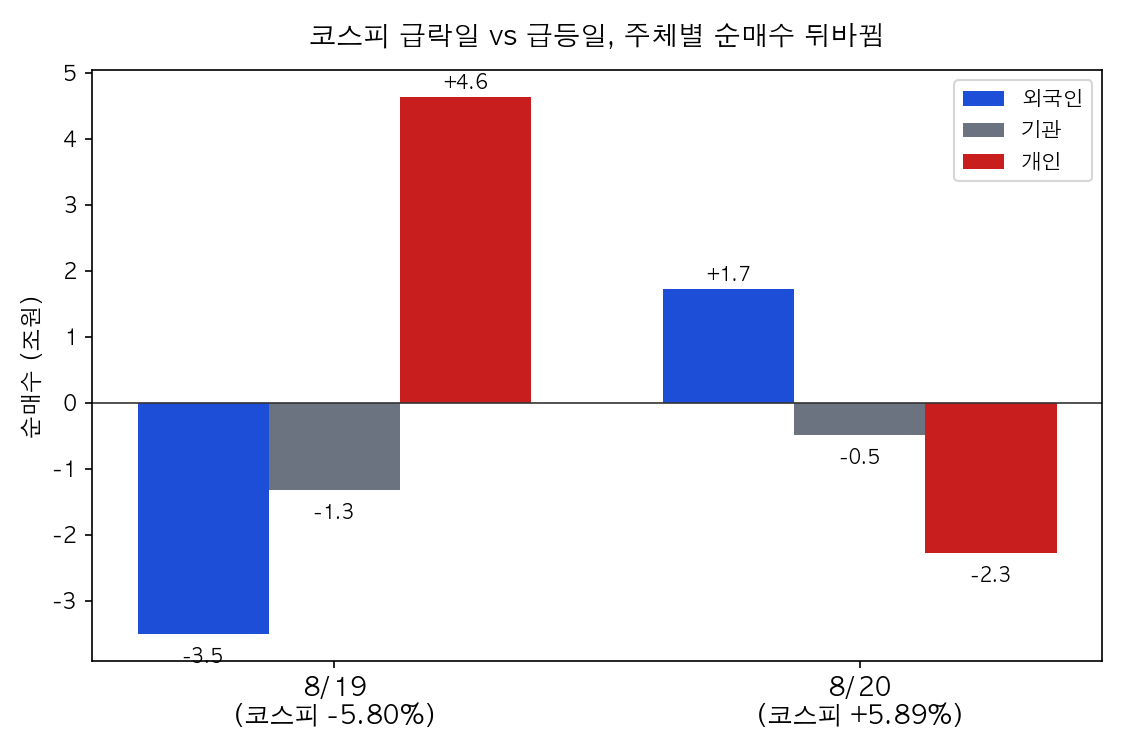
KOSPI seller-buyer breakdown on crash day (8/19) and rally day (8/20)—personally compiled and created
Index and money flow, by the numbers
The KOSPI index gapped up from 6,680, touched a high of 6,904.55 (+6.70%) during the session, then gave back some of those gains to close at 6,852.58. The rally was so large that it triggered the 24th buy-side circuit breaker of the year. Given that the sell-side breaker had been hit the day before, it was unusual to see both buy and sell breakers triggered within just two days.
The KOSDAQ index gained 1.99% to close at 840.89. Retail investors and institutions each showed net buying of ₩0.7 billion and ₩112.5 billion, respectively, while foreigners sold ₩128.1 billion. Notably, on KOSDAQ retail investors were the buyers—the opposite of what we saw on KOSPI.
| Category | 8/19 (KOSPI -5.80%) | 8/20 (KOSPI +5.89%) |
|---|---|---|
| Foreigners | -₩3.5T | +₩1.7T |
| Institutions | -₩1.3T | -₩0.5T |
| Retail | +₩4.6T | -₩2.2T |
Looking at this table, it looks like retail investors who bought cheap yesterday locked in profits and sold today, while foreigners who had stayed on the sidelines came back in to absorb that supply. In the short term, retail did fine—but we need to be mindful of a pattern here. If retail keeps buying on the dip only to sell the next day, they'll eventually get caught holding the bag on the next crash. Going back through 12 years of KOSPI data, one-day crashes do tend to bounce back within a few days, but I wouldn't bet my house on it happening every single time you buy yesterday's lows and sell today's highs.
What really drove today's rally
The index surge was 80% driven by just two heavyweight semiconductor stocks. SK Hynix exploded 12.73% after announcing late yesterday that it would repurchase and cancel 24.07 million common shares (valued at around ₩40 trillion)—the largest shareholder-return decision in the history of Korean listed companies. On top of that, the company pledged to return more than half of cumulative free cash flow from 2025–2027 to shareholders. Samsung Electronics followed suit with a 9.49% gain, after market chatter suggested the company would hold a board meeting in August to decide on a special cash dividend expected to exceed ₩100 trillion.
In other words, when two semiconductor powerhouses essentially said "we're returning this much cash to you," it flipped the script for investors who had been frustrated that great earnings weren't translating to stock price gains. That helped. On top of it, the U.S. Treasury announced it would more than double its long-term bond buyback program from a maximum of $2 billion to at least $4 billion, taking some pressure off the 30-year U.S. Treasury yield, which had hit its highest level since 2007. That also worked in KOSPI's favor.
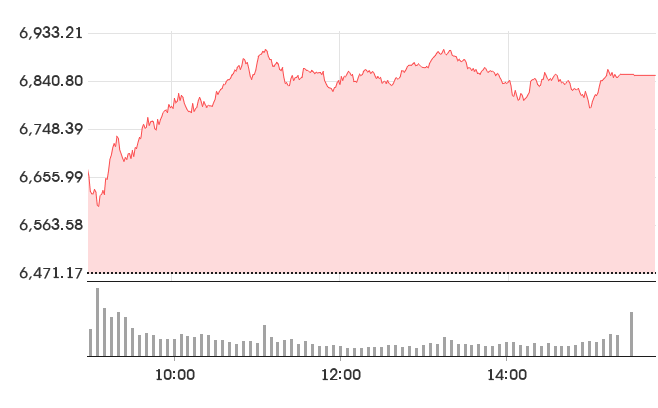
KOSPI index last 3 months, daily (Naver Finance, red=up/blue=down)
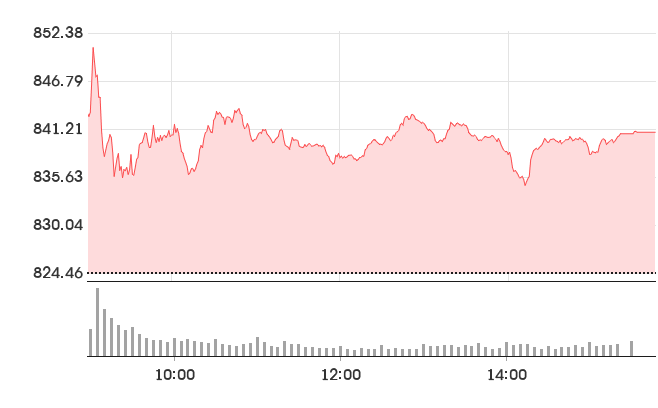
KOSDAQ index last 3 months, daily (Naver Finance, red=up/blue=down)
Winners—Semiconductors and biotech led the charge
Riding the coattails of the semiconductor rally, the electrical/electronics sector climbed 9.19%, taking the top spot among all sectors. SK Hynix even unveiled its roadmap for CPO (co-packaged optics), a next-generation optical connectivity tech, which sent optical comms and 5G-related names higher as well.
On the pharma and biotech side, the spark came from news that Moderna and Merck's jointly developed personalized mRNA cancer therapy passed Phase 3 trials. When Moderna's stock exploded 176.97% in a single session, domestic biotech names followed suit straight to daily limits. Alteogen rose 11.86%, and smaller biotech firms like Syntheca Bio and Alginomics—which have their own drug pipelines—saw sharp gains. But here's something worth noting: these gains aren't driven by better domestic earnings; they're theme-driven rallies riding the coattails of overseas clinical success.
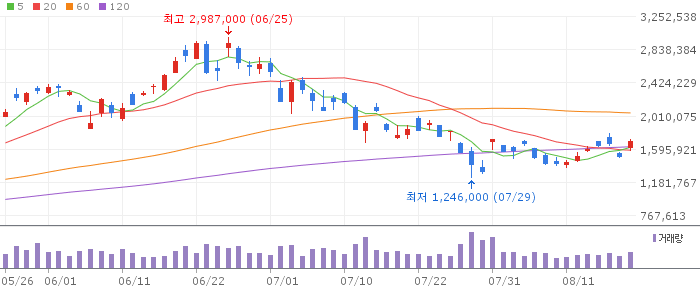
SK Hynix last 3 months, daily (Naver Finance, red=up/blue=down)
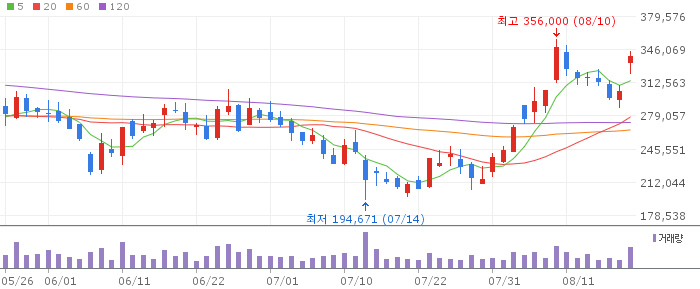
Alteogen last 3 months, daily (Naver Finance, red=up/blue=down)
Losers—Why did financials lag alone?
On a day when nearly all large-cap names were climbing, KB Financial fell 3.85% and Shinhan Financial dropped 3.71%. While the KOSPI surged 5.89%, these two banking heavyweights were the only names marching downward. There was no major negative news specifically for banks that I could spot, so it looks like profit-taking in the defensive banking sector as flows rotated into semiconductors and biotech instead. Looking at sector performance overall, only transportation/logistics (−1.57%), telecom (−1.12%), and construction (−1.08%) moved lower—most everything else was in the black. So today's decline looks more like sector rotation than specific bad news.
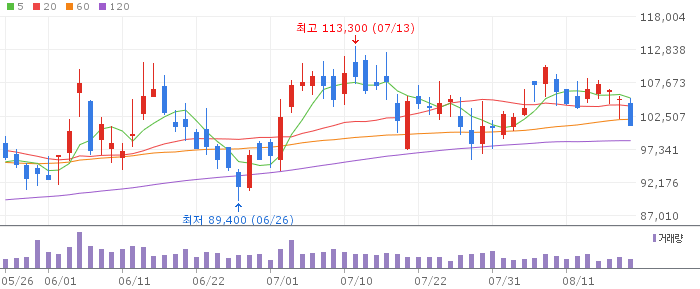
Shinhan Financial last 3 months, daily (Naver Finance, red=up/blue=down)
Today's key takeaways
1) SK Hynix's ₩40 trillion share repurchase and cancellation plan put SK Securities—which is handling the buyback—on the daily limit at +29.79%. With a massive buyback spread over three months, brokerage fees are expected to pile up.
2) The government unveiled a plan to supply over 230,000 homes in the Seoul metro area, sending remodeling and interior design stocks higher. Every time housing supply measures come out, we see a predictable theme pop—and today was no exception.
3) The won-dollar rate moved to 1,392.6, up 3.5 won from the previous session, while the 10-year government bond yield edged down slightly to 4.323%. The declining pressure on long-term rates from the U.S. Treasury's expanded buyback was reflected straight into the domestic bond market.
Wrap-up
These past two days—swinging from a 5%+ crash to a 5%+ rally in 24 hours—showed just how much two semiconductor giants' shareholder-return announcements can move the needle on the whole index. The next thing to watch: what size special dividend Samsung Electronics actually decides on at its board meeting. If it falls short of the market's ₩100 trillion expectation, today's gains could well reverse.
If you're curious why KOSPI crashed yesterday and why retail investors stepped in to buy ₩4.6 trillion at that level, my previous day's close summary walks through that story. And if you want to know why SK Hynix got hammered 9% just days earlier when government bond yields spiked, this piece covers that.
Investment decisions and their outcomes are your own responsibility.
댓글
댓글 쓰기