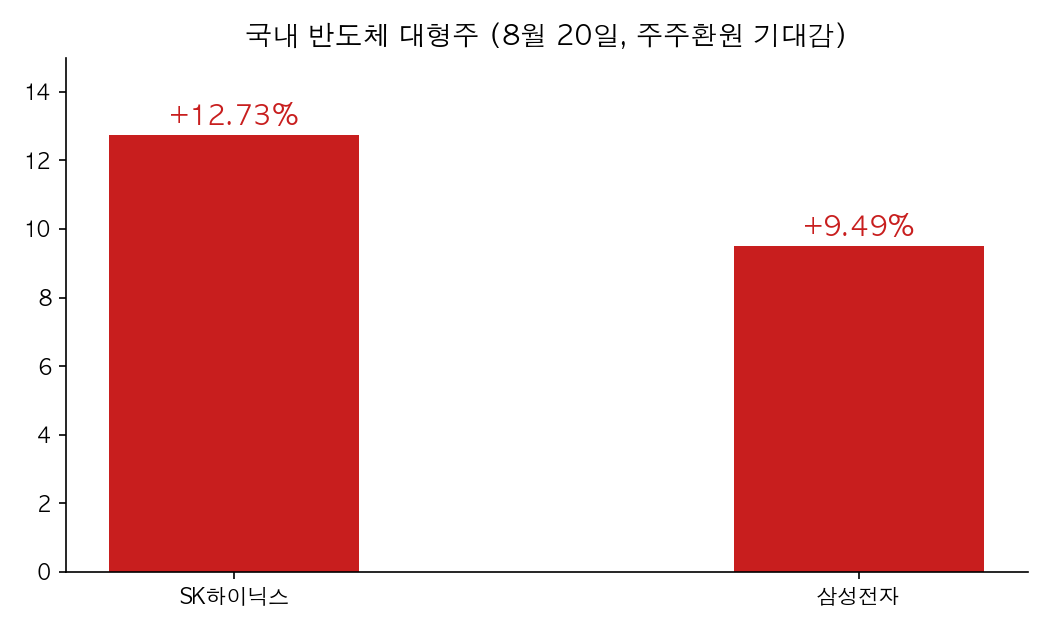
Good morning, August 21, 2026. Yesterday (the 20th), Samsung Electronics surged 9.49% and SK Hynix climbed 12.73% on the Korean market. The move was driven by shareholder return expectations. Meanwhile, the Dow fell 703 points in New York. Treasury yields rose again. Walmart's earnings disappointed. And geopolitical tensions around Iran added to the mix. Today, the Kospi is launching with both currents weighing on it at the same time.
Indeed, the Kospi opened this morning down about 1%, retreating to the 6,240 level. Samsung and SK Hynix also turned weak right after opening. Today's key question: can yesterday's shareholder return optimism hold its ground?
The Three Major U.S. Indices Reverse to the Downside in a Single Day
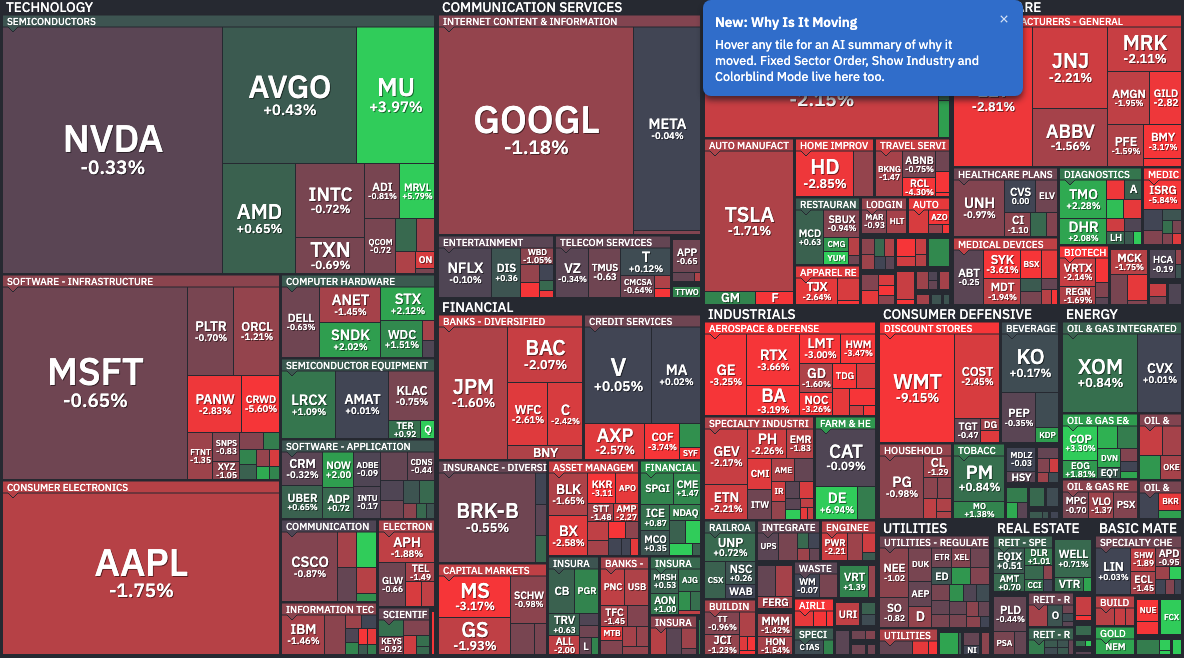
Last Night's U.S. Market Map (S&P 500 Heatmap) · Green=gainers/Red=decliners (finviz U.S. style)
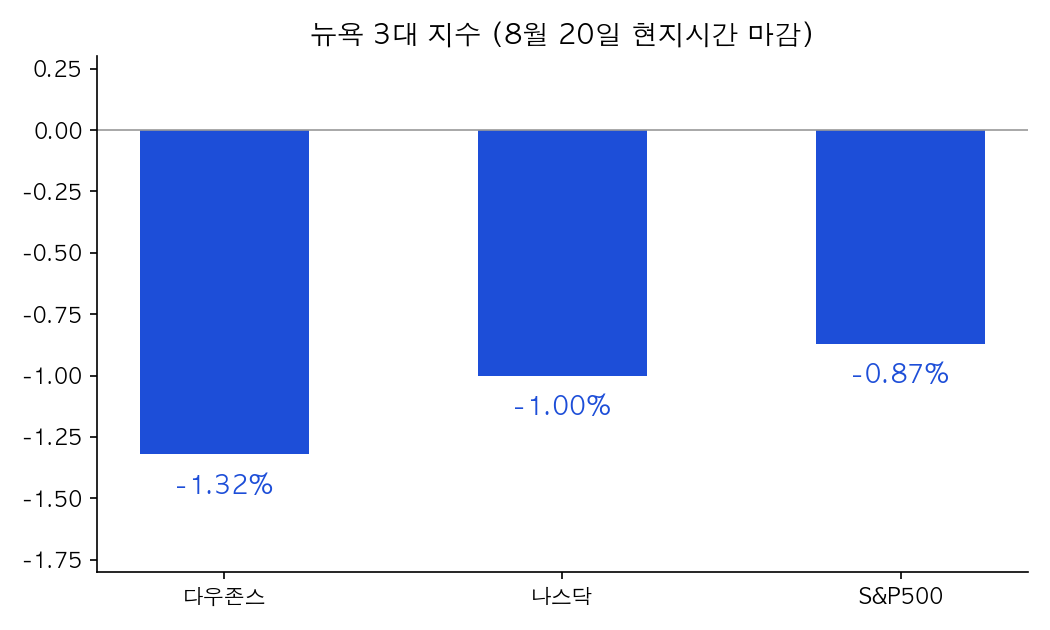
On August 20 (U.S. time), all three major indices declined together. The Dow fell 703.84 points (-1.32%) to close at 52,759.21. The Nasdaq dropped 263.92 points (-1.00%) to 26,067.17, and the S&P 500 retreated 66.82 points (-0.87%) to 7,641.16. The Russell 2000 small-cap index saw even bigger swings, down 1.34%.
The day before, when the U.S. Treasury announced it would double the size of long-term Treasury buybacks, yields plunged. But in just one day, that trend reversed. The market decided: "This is only a temporary fix." Then the hawkish July FOMC minutes came on top of it. Walmart posted sales that disappointed expectations. The stock dropped 9.7%. President Trump also made remarks suggesting he'd "devastate" Iran's economy. That's why Middle East risk came back into focus.
A complete reversal happened in a single day. The market that found relief in the Treasury buyback announcement simply rediscovered its limitations a day later.
Semiconductors: Korea Surges While New York Slides
Korea's semiconductor heavyweights were brilliant yesterday. SK Hynix announced it would acquire and retire its own shares worth roughly 40 trillion won. Samsung Electronics is set to hold a board meeting this month to approve shareholder returns including special cash dividends exceeding 100 trillion won. The result was the double-digit gains we saw above.
But the vibe in New York was different. The Nasdaq slid close to 1%. Along the way, semiconductor and AI stocks took collateral damage. News broke that Intel is planning a capital raise. Concerns that "AI investment burden remains heavy" surfaced again. The news that OpenAI had widened its losses in its latest earnings also fanned anxiety about AI valuations.
To sum it up: Korean semiconductors soared on the discrete catalyst of "shareholder returns," while U.S. semiconductors got crushed by sector-wide concerns about "AI investment burden." The fact that Samsung and SK Hynix turned weak right after opening this morning signals that these two forces are beginning to collide.
Where Are Rates, Exchange Rate, and Oil Headed?
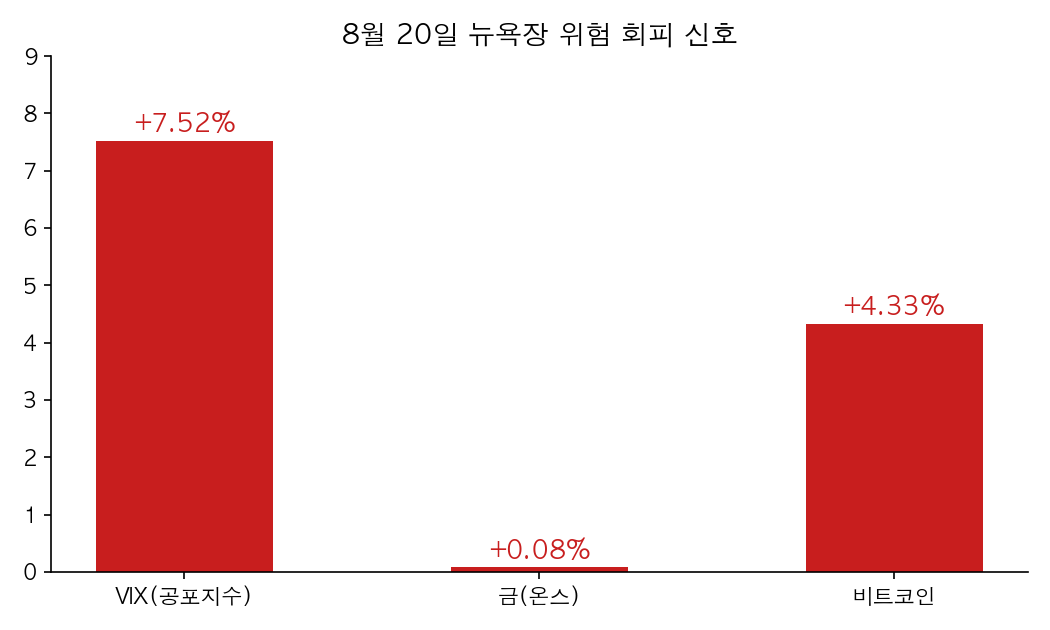
The VIX, known as the fear gauge, jumped 7.52% in a single day to 16.01. The absolute level itself is still low. But the direction—pointing upward—is what stands out. Gold, the traditional safe haven, managed only a modest (+0.08%) gain. Bitcoin, on the other hand, surged 4.33%. Even within risk assets, reactions diverged.
Oil prices (WTI basis) fell 0.71% to $86.21 a barrel. Geopolitical tensions around Iran persist. But the recent surge has caught its breath for now. The won-dollar exchange rate climbed to the 1,418 range. That means the won's weakness is continuing. When rising Treasury yields pair with a stronger dollar, it spells pressure for foreign investor flows.
Asian Markets Closed Higher the Previous Session
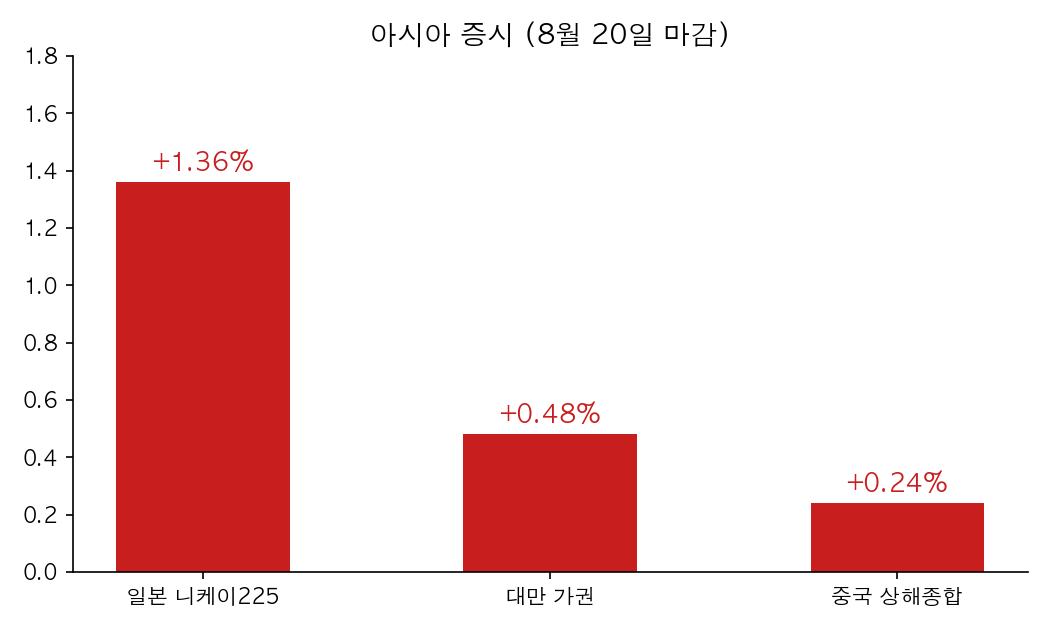
When you account for time differences, Asian markets reflected not New York's decline (20th) but the rebound from the day before (19th). Japan's Nikkei 225 closed up 1.36% at 66,216.79 yen on strength in semiconductors and pharma stocks. News of Korea's semiconductor giants' surge pulled up related Japanese names like Kioxia, Fujitsu, and Advantest. Taiwan's Taiex also gained 0.48% on success in TSMC's 1.6nm process development. China's Shanghai Composite closed up 0.24% as pharma and biotech shares rallied on news of clinical success for the Moderna-Merck co-developed mRNA cancer vaccine.
So all three Asian nations rode "yesterday's tailwind" higher, while New York's move that broke that wind hadn't yet made its way into Asian markets. Today's opening of the Korean market was the first to reflect it.
Japan's Nikkei opened higher at 65,732.79 yen and briefly climbed to 66,325.32 in the session. It gave back some gains in the afternoon but closed at 66,216.79 yen. Taiwan's Taiex reversed yesterday's decline of over 1% in a single day—its first bounce in three trading days. China's Shanghai Composite dipped briefly to 3,888.10 and even turned negative intraday, but climbed back into positive territory by the close. All three countries saw volatility, but they shared one thing: the final direction was up.
Today's Domestic Market Watch Points
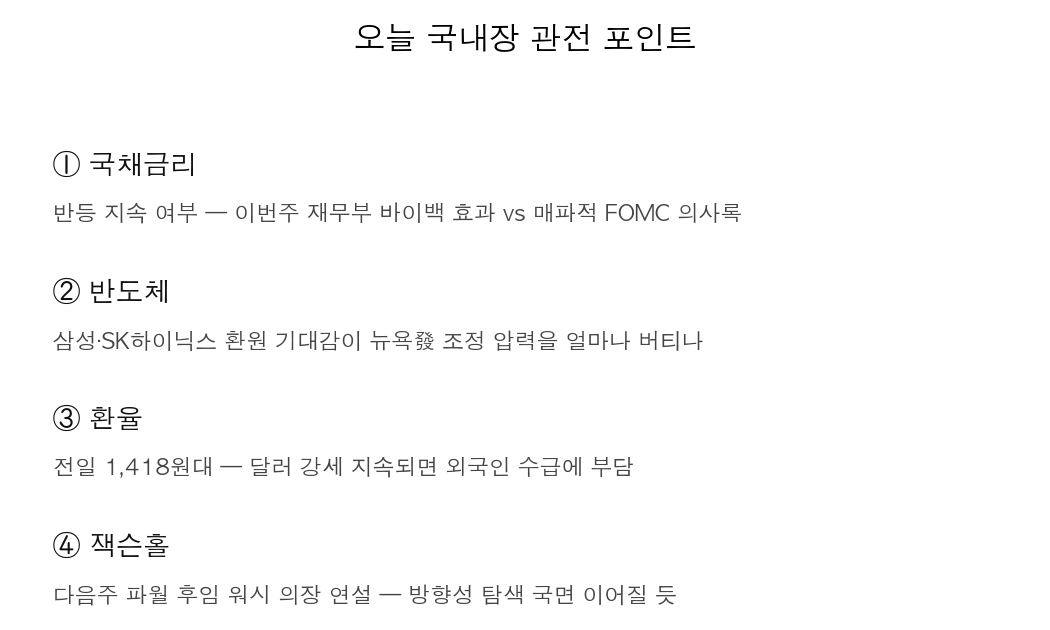
Today, the Kospi looks like it will be a day when two forces collide. One is the lingering shareholder return expectations for Samsung and SK Hynix from yesterday. The other is the rate and inflation caution that woke up in New York overnight. Indeed, the Kospi opened down about 1%, falling to the 6,240 level, and both semiconductor giants turned weak right after opening.
I've laid out today's key watch points in the table below. Note: this isn't a buy or sell recommendation—just a summary of what the market might react to today.
The flow of semiconductor heavyweights, in particular, has outsized influence on Korea's entire supply-demand picture. The fact that Samsung and SK Hynix both turned weak this morning after yesterday's surge is hardly independent of New York's overnight pressure on semiconductor and AI stocks. But the two Korean names' gains came not from earnings or sector conditions, but from a discrete event—shareholder returns. So there's room for them to hold ground with a different kind of strength than New York's correction. Where these two names attempt a rebound during today's session could be a clue to the Kospi's overall direction.
| Item | Watch Point |
|---|---|
| Semiconductor Shareholder Returns | Whether Samsung's board dividend proposal and SK Hynix's buyback schedule actually materialize into concrete details |
| Treasury Yields | Whether the buyback effect springs back to life, or if the hawkish FOMC minutes continue to echo |
| Exchange Rate | If won-dollar climbs further from the 1,418 range, it will impact the intensity of foreign investor net buying |
| Jackson Hole Symposium | The tone from Fed speakers scheduled for next week will be the next variable shaping this week's direction |
The Bottom Line
Yesterday, Korea's semiconductor heavyweights surged powerfully on their own shareholder return story. Today, both that momentum and New York's overnight reversal arrive at the market simultaneously. Which force will dominate is something we'll only know once the market opens. But variables like Treasury yields, the exchange rate, and the Jackson Hole schedule—ones that will keep showing up all week—are worth watching today as well.
This article is provided for informational purposes to support investment decision-making and does not recommend buying or selling any specific stock. Investment decisions and their outcomes rest with you.
#KospiIndex #NYStockExchange #NYClose #DowJones #NasdaqIndex #S&P500 #PhiladelphiaSemiconductor #SamsungElectronicsStock #SKHynixStock #TreasuryYields #WonDollarRate #CrudeOilPrices #WTI #VIX #JacksonHole #USMarket #KospiOutlook #TodaysMarket #SemiconductorStocks #ShareholderReturns #StockBuyback #SpecialDividend #FederalReserve #FOMC #Walmart #Intel #TSMC #NikkeiIndex #ShanghaiComposite #TaiwanWeightedIndex #Moderna
댓글
댓글 쓰기