[NYSE] KOSPI Index Climbs as S&P500 Hits All-Time High—So Why Did the Semiconductor Index Only Rise 0.46%?
Last Friday (August 14), the KOSPI index closed at 6,977.94, surging 2.42%. This came right after the previous night (August 13 US time) when the NYSE saw the S&P500 hit a new all-time high, sending all three major indices higher in lockstep. Yet the Philadelphia Semiconductor Index (SOX)—the very gauge that's supposed to back up gains in domestic chip stocks—managed just a 0.46% rise. One index at record levels, the other up modestly. That spread in momentum is something worth watching closely as we navigate today's domestic market.
To cut to the chase: US inflation data (PPI) came in below expectations last night, easing concerns about rate hikes significantly, and oil prices crashed. Both of these pushed the risk-on sentiment higher. On the surface, semiconductors looked calm as a sector, but dig into individual names and you get a different story. SanDisk soared over 13% after laying out a long-term growth outlook at an investor event, projecting double-digit annual growth for fiscal 2028–2030 driven by AI infrastructure buildout. SK Hynix ADR also popped over 7%. This momentum rolled straight into Friday's KOSPI semiconductor strength.
The Big Three US indices—with the S&P500 setting new records
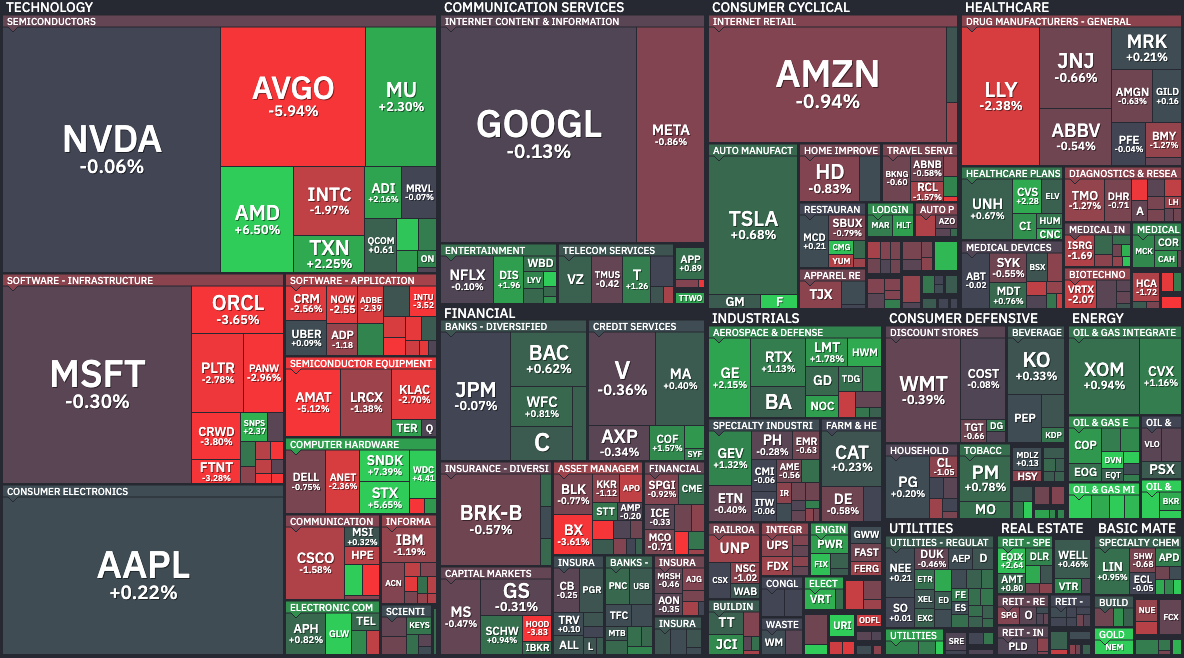
US market map from last night (S&P500 heatmap) · Green=gains/Red=losses (finviz US color scheme)
On August 13 (US time), the NYSE closed with the Dow +0.13%, Nasdaq +0.81%, and S&P500 +0.65%—all three indices higher. The S&P500's 7,798.99 mark is an all-time high. The Labor Department's July Producer Price Index (PPI) came in flat month-over-month (0.0%), missing the market's forecast of a 0.2% rise. Combined with yesterday's CPI reading, this confirmed the disinflation trend, taking some heat off rate-hike fears.
Wall Street last night · S&P500 hit new heights on inflation relief
| Index | Close | Change |
|---|---|---|
| Dow Jones | 53,839.99 | +0.13% |
| Nasdaq Composite | 26,803.03 | +0.81% |
| S&P500 | 7,798.99 | +0.65% (All-time high) |
| Philadelphia Semiconductor (SOX) | 12,456.00 | +0.46% |
Breaking it down by name: SanDisk led with a 13.67% pop. They outlined a long-term guidance at an investor day that fiscal 2028–2030 revenue will grow in the high-teens range annually, backed by AI infrastructure expansion. Western Digital (+7.31%), Seagate (+4.91%), and Micron (+4.23%) rode the coattails. Big tech names like Tesla (+3.80%), Meta (+2.78%), and Apple (+1.00%) mostly climbed, while Netflix surged 5.43% on news that activist investor Bill Ackman's Pershing Square took a new stake. On the flip side, Cisco Systems (-8.40%) and Cerebras Systems (-11.85%) tanked after earnings misses disappointed investors on guidance.
Why the Philadelphia Semiconductor Index Climbed Just 0.46%—and Why That Matters
Semiconductor wafer production line · The index was muted, but memory names were individually strong
Looking only at the index's modest gain, you might think the chip rally has fizzled. But peel back the layers and there's a wide gap between individual names. Nvidia (+0.54%) and AMD (roughly flat) barely moved, and TSMC (+0.31%) eked out a small gain. Memory stocks, though? That's where the action was. SanDisk +13.67%, SK Hynix ADR +7.29%, Micron +4.23%, Intel +3.58%. This reflects money flowing back into memory names after they'd sold off—thanks to renewed AI data center investment plans from Microsoft, Amazon, and other megacaps.
For the Korean market, that SK Hynix ADR strength is particularly significant. On Friday, KOSPI's SK Hynix (+3.26%) and Samsung Electronics (+2.43%) led the broader index higher, while Samsung Electro-Mechanics (+3.66%) and SK Square (+3.31%) tagged along. The semiconductor index itself rose modestly, but the individual strength in memory stocks flowed right through to Korea's chip heavyweights.
Interest Rates, Currency, Oil—Signals Coming Home to Korea

International oil prices crashed over 2% in a single day on weakening demand outlook
The US 10-year Treasury yield fell 4.3 basis points to 4.640%, while the 2-year dropped 6.1 basis points to 4.138%. Bond prices rose (yields fell) as relief over PPI and falling oil converged. By the Chicago Mercantile Exchange's FedWatch metric, the odds of a September rate hold jumped from 59.4% to 67.6% in a single day. Still, one thing to watch: a $25 billion auction of 30-year Treasuries priced at a yield of 5.216%, the highest since 2001. That signals weaker-than-expected demand from long-bond investors.
Oil prices plunged. WTI September futures fell 2.43% to $81.25 per barrel, while Brent October futures dropped 2.15% to $87.07. The culprit: reports that crude exports through the Strait of Hormuz came in higher than expected, easing some Middle East supply concerns, and the IEA downgraded its 2024 global oil demand forecast. The dollar index held roughly flat at 99.96, and the dollar-won rate was just 0.3 won weaker at 1,418.3 by 3:30 PM Friday. Foreign investors' $3 trillion-plus net purchases of KOSPI shares provided some support for the won, though concurrent yen weakness capped the won's gains.
Asian Markets Yesterday—Why Taiwan Hit Pause

Japan's Nikkei climbed higher, lifted by semiconductor stocks
On August 14, Japan's Nikkei 225 rose 0.59% to 68,713.80, led by semiconductor names like Kioxia Holdings (+3.75%) and Advantest (+2.59%). China's Shanghai Composite barely budged at 3,927.18, up just 0.01%, as investors played it cautious ahead of next week's key economic data releases on unemployment and industrial production.
The standout is Taiwan's Taiex. After five straight days of gains, it closed 0.46% lower at 45,811.01. Profit-taking hit TSMC, which had been driving the rally—it fell 1.64% on the day. Traders took notice of technical resistance around the 46,000 level and became cautious about near-term froth. The KOSPI, too, has now rallied five straight days and sits just shy of 7,000, so Taiwan's pause pattern is worth keeping an eye on.
What to Watch in Today's Korean Market
KOSPI closed Friday just 22 points below the 7,000 level after five straight days of gains
The KOSPI ran up five days in a row, closing Friday at 6,977.94—just 22 points shy of 7,000. Against that backdrop, last night's US data looks fundamentally supportive, though there are a few threads worth following.
First: semiconductors. The SOX index was muted, but SK Hynix ADR and memory peers like SanDisk and Micron were clearly strong. The question is whether that momentum carries into Samsung Electronics and SK Hynix today, or whether profit-taking shows up like it did in Taiwan. Second: the oil crash cuts input costs for refiners, airlines, and shippers, but the underlying demand-weakness story could ripple across sectors in mixed ways. Third: higher expectations for a September Fed hold favor risk assets, but weak demand in yesterday's long-bond auction leaves a lingering concern about longer rates that could weigh on financials and construction.
Domestically, there's also chatter about LG Group Chairman Koo Kwang-mo and Nvidia CEO Jensen Huang meeting, as well as buzz around Anthropic's IPO plans and a $2 trillion valuation, which has SK Telecom back in focus. But how these narratives actually play out once the market opens is still an open question.
Wrap-Up
Last night, the NYSE clinched new records on two bullish backings: inflation relief and a crash in oil. The semiconductor index itself was quiet, but memory stocks underneath were strong—a theme we already saw play out Friday in KOSPI's big chip names. With KOSPI five days into a rally and sitting just below 7,000, today's question is whether the momentum carries or we take a breather, Taiwan-style.
This article is for informational purposes only and does not constitute a buy or sell recommendation for any specific security. Investment decisions and their outcomes are your own responsibility.
#NYSE #KOSPIIndex #USMarketClose #S&P500 #NasdaqIndex #DowJones #PhiladelphiaSemiconductor #SOX #SKHynix #SamsungElectronics #SemiconductorStocks #CrudeOil #WTI #DollarWon #USTreasuryYield #KOSPIOutlook #TodaysMarket #AsianMarkets #NikkeiIndex #TaiwanTaiex #ShanghaiComposite #FedRateHold #PPIData #RateCutExpectations #SanDisk #Micron #KOSPI7000 #ForeignBuying #MarketAnalysis #InvestmentInfo #StockMarket
댓글
댓글 쓰기