Good morning, August 14, 2026. Last night, the U.S. market saw the Dow Jones slip slightly (-0.04%) as July's consumer price index came in as expected, while Nasdaq (+0.54%) and S&P 500 (+0.26%) climbed. This trend, in fact, was already reflected in the KOSPI the day before. On August 13th, the KOSPI closed at 6,813.34, up +234.30 points (+3.56%) in a single day. Today's key question for the domestic market is whether the semiconductor-led rally still has momentum the day after this sharp surge.
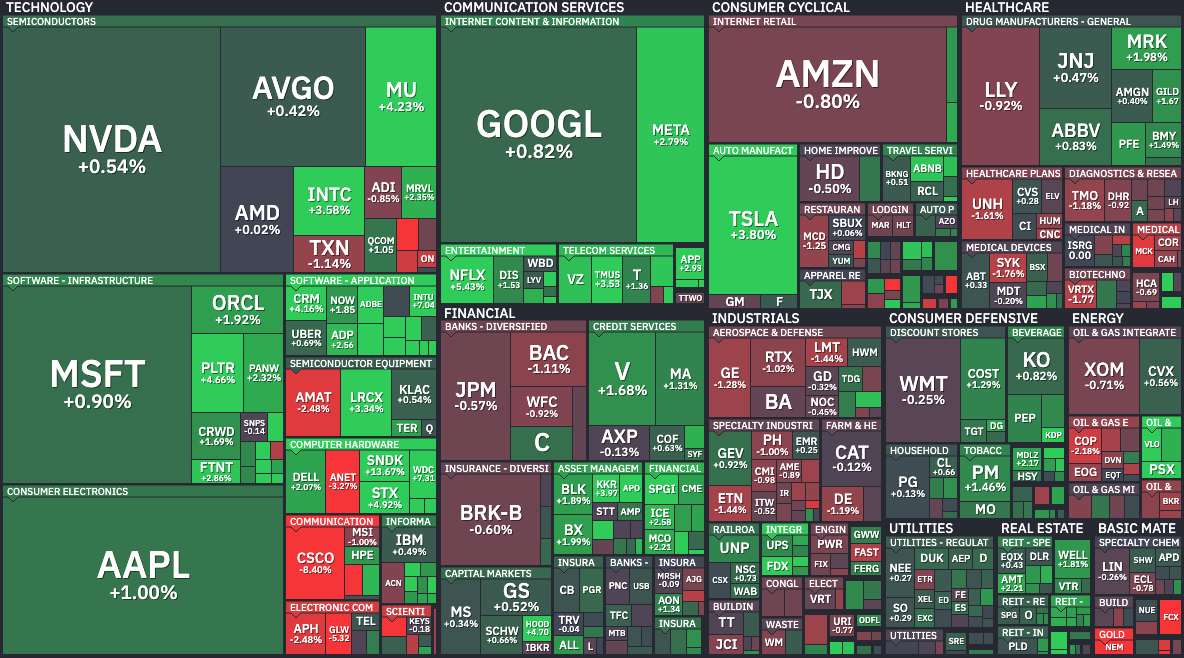
Last night's U.S. market map (S&P 500 heatmap) · Green = up / Red = down (finviz U.S.-style colors)
U.S. Major Indices: Inflation Eased Worries, But Big Tech Stocks Got Sold
The Dow Jones Industrial Average closed at 53,770.27, down 21.58 points (-0.04%), the Nasdaq Composite at 26,588.49, up 143.04 points (+0.54%), and the S&P 500 at 7,748.50, up 20.30 points (+0.26%). July's CPI, released by the U.S. Department of Labor, rose 3.4% year-over-year, cooling from June's 3.5%, while core CPI came in at 2.5%, down from June's 2.6%. Based on the CME FedWatch Tool, the odds of a rate hold in September jumped to 62.0%.
But what actually drove stocks higher that day wasn't the inflation figures—it was individual earnings reports. AI cloud provider CoreWeave soared +19.28%, Nevius Group jumped +34.14%, and server maker Supermicro Computer surged +19.02%. CoreWeave's Q2 revenue hit $2.58 billion, up 112% year-over-year, and its backlog swelled to $104.2 billion. Supermicro guided next quarter's revenue well above consensus at $14.5–$15.5 billion. On this news, SK Hynix ADRs jumped +9.01%, Micron rose +4.92%, and Nvidia climbed +3.03% in sympathy. Meanwhile, mega-cap tech stocks like Meta (-3.38%), Microsoft (-2.26%), Tesla (-1.59%), Amazon (-1.83%), and Apple (-0.87%) mostly fell. It was a day when money poured into AI infrastructure and semiconductors while profit-taking hit mega-cap tech stocks that had already rallied hard.
Philadelphia Semiconductor Index +2.49% — A Direct Link to Korean Semiconductors
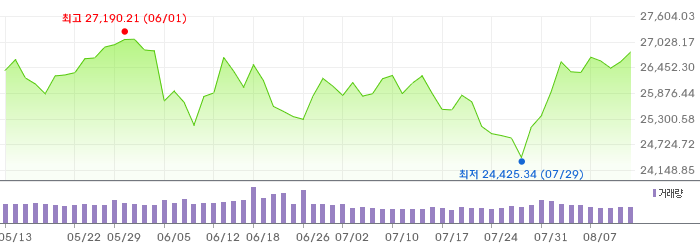
Nasdaq Composite: 3-Month Trend
The number Korean investors should watch most closely is the Philadelphia Semiconductor Index (SOX). The index closed at 12,399.38, up 300.90 points (+2.49%). Most semiconductor stocks rose—Nvidia +3.03%, AMD +1.82%, TSMC +1.68%, Micron +4.92%—along with ASML, Intel, AMAT, Lam Research, Arm, KLA, and Marvell Technology. As earnings showed AI infrastructure demand remains unbroken, buying interest concentrated across the entire semiconductor supply chain.
This trend already flowed straight into Korea's market yesterday. The KOSPI jumped to the 6,813 level in a single day as semiconductor stocks led by Samsung Electronics and SK Hynix surged. Today's key question is whether fresh buying momentum remains, given that the SOX +2.49% catalyst was already substantially priced in yesterday.
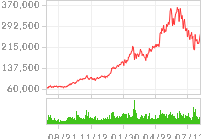
Samsung Electronics: 1-Year Stock Price Trend
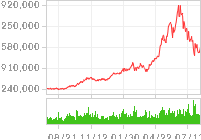
SK Hynix: 1-Year Stock Price Trend
Interest Rates, Forex, Oil: Relief and Unease in Equal Measure
The U.S. 10-year Treasury yield held near steady at 4.683%, the 2-year fell slightly to 4.199%, and the 30-year rose to 5.246%. The 10-2 spread widened from 46.80 bp to 48.40 bp. In the same day's $42 billion 10-year Treasury auction, the yield came in at 4.683%, up 10.3 bp from the previous month and marking the highest level since 2007. The next key report is July's Producer Price Index (PPI), which could shake the market's expectations for a September rate hold built in over the past day.
The dollar showed strength against the yen and euro. Dollar-yen hit 159.501 yen (+0.217 yen), while euro-dollar came in at 1.1522 dollars (-0.0021 dollars). The dollar strengthened despite the CPI relief due to lingering U.S.-Iran tensions over the Strait of Hormuz. In fact, only 14 vessels transited the Strait of Hormuz on August 11th alone, a plunge of roughly 90% compared to the pre-conflict daily average of 120–130 ships. Yemen's Houthi militants have attacked cargo ships in the Red Sea, causing casualties, and U.S. forces have struck container vessels in the Gulf of Oman—military tensions remain elevated. In Korea's forex market, the won-dollar rate rose 0.9 won (+0.06%) to 1,419.4 won (as of 3:30 p.m.) on settlement demand and dollar strength.
Crude oil prices held firm as U.S.-Iran talks remained at an impasse: WTI closed at $83.27 a barrel (+0.08%) and Brent at $88.98 (+0.08%). U.S. commercial crude stockpiles rose by 17.4 million barrels—the opposite of the market's 1.4 million barrel decline expectation—yet oil held steady, suggesting the market weights physical bottlenecks at the Strait of Hormuz more heavily than inventory swings.
Previous Day's Asia Markets — Taiwan Kept Rising, China Took Profits
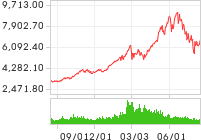
KOSPI: 1-Year Trend
On August 13th, Asia's stock markets showed a stark divergence. Japan's Nikkei index, boosted by AI optimism, closed at 68,308.59 yen, up 784.53 yen (+1.16%), fully capturing the earnings tailwind from CoreWeave, Nevius, and Supermicro. Taiwan's Taiex also continued its rally, rising 503.41 points (+1.11%) to 46,021.48. Also noteworthy: foreign investors net-bought $1.7 billion of Taiwan stocks this month, breaking a 6-week selling streak.
Meanwhile, China's Shanghai Composite briefly rose as much as +0.55% intraday but closed at 3,926.97, down 19.71 points (-0.50%), pressured by late-session profit-taking. The People's Bank of China's commitment to an accommodative stance, absent any concrete signals on rate or reserve requirement cuts, fueled disappointment selling. Despite receiving the same AI tailwind, Japan and Taiwan held their gains to the close, while China gave back its morning gains by the afternoon. As we gauge whether the KOSPI will keep climbing today, watch for whether this 'buy morning, sell afternoon' pattern repeats.
Today's Domestic Market Watchpoints
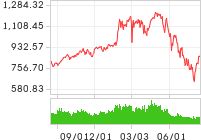
KOSDAQ: 1-Year Trend
Yesterday, the KOSPI surged to 6,813.34 led by semiconductor stocks as foreigners and institutions bought in unison, while the KOSDAQ edged up to 861.37 on retail buying. With the index up 3.56% in a single day, the first variable is whether these gains stick or if we see an afternoon selloff like in China's Shanghai index.
| Item | Yesterday's Result | Watch Today For |
|---|---|---|
| Semiconductors (SOX) | +2.49% | The catalyst is already priced into KOSPI; room for additional gains |
| U.S. Treasury Yields | 10-year at 4.683% | Swings based on PPI release |
| Won-Dollar Rate | 1,419.4 won | Further dollar strength, foreign flow impacts |
| Strait of Hormuz | Transits down ~90% | Risk of oil and inflation back in focus |
Second is the MSCI Korea Index periodic reshuffle. MSCI's August quarterly review will add LG Innotek and drop four stocks including HLB and LG Display. While the change takes effect after market close on August 31st, index-linked flows often move ahead of the effective date, making it worth watching from today.
Third is the reallocation within semiconductor leaders. Morgan Stanley shifted its top pick from Samsung Electronics to Samsung Electro-Mechanics and raised its price target to 2.62 million won. Samsung Group's market cap reclaimed 2 quadrillion won yesterday; today's flow question is which group stock absorbs the buying. In Q2 NAND, Samsung Electronics held first place, SK Hynix second, and China's YMTC entered the top 3 for the first time—another data point for tracking Korean semiconductor flows.
Fourth is tonight's scheduled U.S. July PPI release and 30-year Treasury auction. CPI eased worries, but if PPI comes in hotter than expected, September's rate-hold odds could shake. One investment bank flagged 'August CPI as the problem,' cautioning that if oil stays near current levels, inflation could rebound to 3.7%. Separate from today's rally, the data could reset the market mood later this week—keep that possibility on the table.
Bottom Line
Last night, the U.S. market saw Nasdaq and S&P 500 rise on inflation relief and AI infrastructure earnings optimism, pulling the Philadelphia Semiconductor Index up 2.49%. This trend already lifted the KOSPI 3.56% yesterday, reflecting much of the move. Today, watch whether the semiconductor rally has legs the day after this surge, and when worries like Strait of Hormuz tensions or the coming PPI report resurface. Rather than pick a direction, better to monitor how the variables in the table above play out during the session and adjust accordingly.
This article is for informational purposes to help with investment decisions and does not constitute a buy or sell recommendation for any stock. All investment decisions and their consequences rest with you.
#USmarkets #KOSPIindex #KOSPIoutlook #UScloseout #semiconductorindex #Philadelphiasemiconductor #Nasdaqindex #SP500 #DowJones #SamsungElectronics #SKHynix #Nvidia #CPI #Federalrates #wondollarrate #crudeoil #Treasuryyields #StraitofHormuz #AIsemiconductors #SupermicroComputer #CoreWeave #MSCIKoreaindex #MorganStanley #SamsungElectroMechanics #todaysmarkets #KoreanmarketOutlook #KOSDAQindex #marketanalysis #stockinvesting #economicnews #investmentinfo
댓글
댓글 쓰기