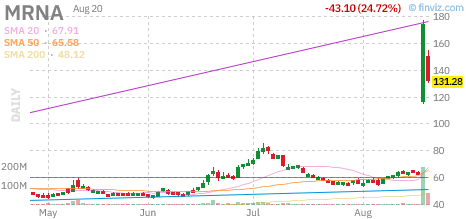
Moderna (MRNA) stock went on a roller coaster ride this week. Closing price on Tuesday, August 18th: $62.96. The next day: $174.38. In just one day. That's a +176.97% gain—the largest single-day jump in the company's history. By search cross-check, it's reportedly the biggest single-day rally for any S&P 500 stock this century.
But then just the next day—Thursday, August 20th. As I'm writing this, U.S. markets are still open. The stock is hovering around $130, down roughly -25% from the previous day. The closing price isn't final yet. The intraday high was $155, the low around $129. It's not a crash. It's more accurately a pullback after the surge. Compared to the August 18th close, it's still up more than double over the two-day span.
The Nasdaq wasn't shaken today, so why just Moderna?
I looked at the broader U.S. market first on the 20th. At the same time, S&P 500 was -0.32%, Nasdaq -0.71%. The market was nudged down slightly due to an announcement of expanded Treasury purchases and rising oil prices. But that alone doesn't explain Moderna's -25%.
It's down 30 times more than the broader index. It's not the market. It's a stock-specific issue. The answer lies in what happened the day before—and the market's reassessment of it.
So What Exactly Happened?
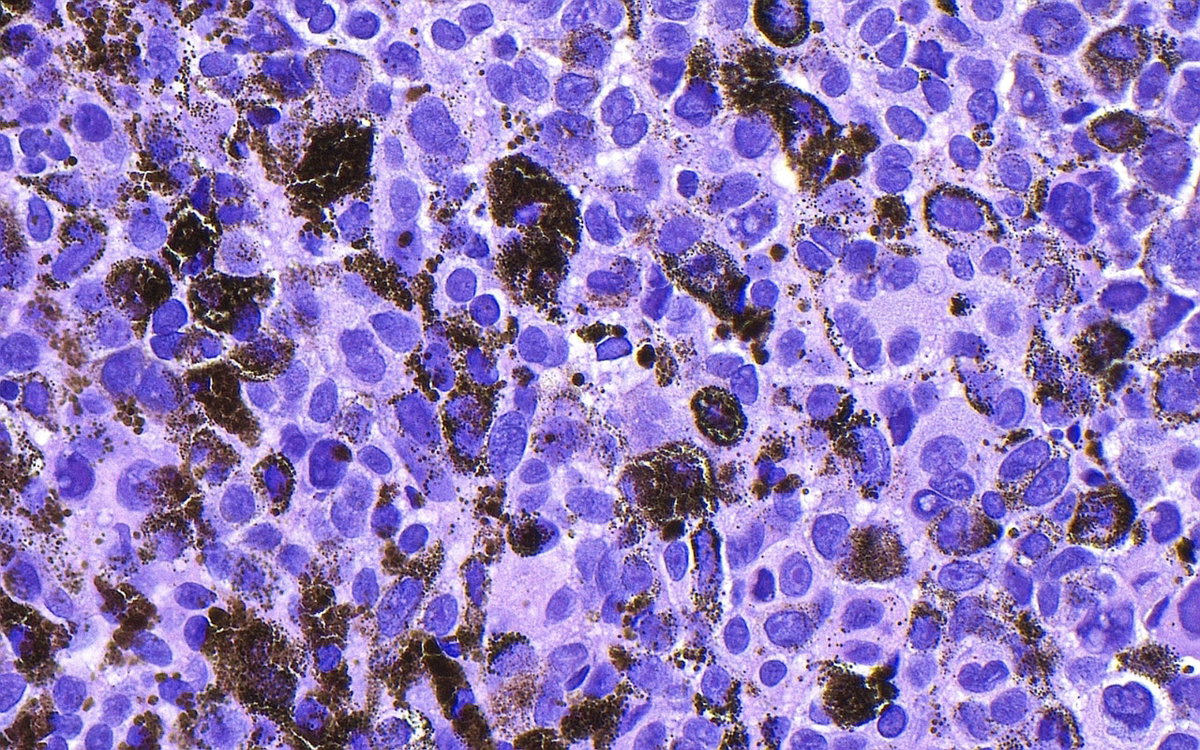
On the evening of the 19th (Korea time), Moderna and Merck released a joint announcement. The Phase 3 clinical trial is called INTerpath-001. It enrolled over 1,100 patients with stage 2B-4 melanoma (skin cancer) who had complete resection. Both primary endpoints were met, according to the press release.
The drug is called intismeran autogene—an mRNA cancer therapy customized for each patient by analyzing their tumor's genetic makeup. It's used together with Merck's Keytruda. Here are the results: recurrence-free survival—in other words, how long patients remained cancer-free after surgery. It was significantly longer than Keytruda alone. The same was true for distant disease-free interval.
Why is this such a big deal? Because it's the world's first successful Phase 3 trial for both a personalized neoantigen therapy and an mRNA-based cancer drug. Moderna CEO Stéphane Bancel reportedly called it a day on par with Moderna's November 2020 announcement of its COVID vaccine Phase 3 success.

But Why No Detailed Numbers?
Here's where it gets odd. There are no numbers anywhere in the press release. No hazard ratio (HR), no percentage point improvement in recurrence rate. Just the phrase "significantly improved."
I'm not sure why they didn't release the detailed numbers. It seems they might be waiting for a conference presentation and regulatory consultations. The company hasn't explained the exact reason. Approval timeline, sales projections—nothing is concrete yet. Both companies only said they plan to file for approval within a few months.
Market cap nearly tripled in a single day with zero numbers released. That's a bit much. The market seems to have had the same thought. That's probably why we saw the pullback on the 20th.
Analysts Raised Price Targets, But...
In a single day on the 20th, Wall Street firms were busy revising their price targets. RBC Capital went from $45 to $130. Bank of America went from $40 to $170. Both are substantial moves.
But both target prices are lower than the August 19th close of $174.38. Even with nearly tripling its target, RBC kept its rating at Neutral (Sector Perform). The company's valuation clearly jumped. But not by as much as the market priced it in a single day. That's the core logic behind the pullback.
The Company Itself Still Isn't Making Money
Overshadowed by the clinical news, we should also touch on Q2 earnings. Revenue was $145 million. That's 2% growth year-over-year. But net loss was $782 million. On a per-share basis, that's -$1.97.
The good news: cash is still comfortable. Cash and investments stood at $6.9 billion at quarter end. The company says it will maintain $4.7–$5.2 billion through year-end. That said, they paid out a $950 million litigation settlement in July. That's worth knowing. With the COVID vaccine boom behind us, Moderna still isn't a money-making company. It's a company that keeps burning cash on its drug pipeline.
So What Should We Be Watching?
Here's the summary: the world's first successful Phase 3 trial for a melanoma therapy is a genuine positive, not hype. But in the process of pricing it in, the market got a bit too excited for one day (+176%) and is now giving back about a quarter of those gains. The $130–$170 range the analysts just laid out is probably a more sober valuation.
If I had to sum it up: the trial itself is real, and the company's long-term story has changed, but the current price is still being digested.
The key thing to watch is just one: when the conference reveals those detailed numbers—hazard ratio, recurrence rate, etc. Whether those figures come in as strong as the market expects will determine the next move. How should you view this stock? I can't say for certain. But one thing is sure: it will move big on the day those numbers come out.
From COVID Company to Cancer Company
Moderna is in the middle of transforming from a "COVID vaccine company" to a "cancer mRNA company." This week was clearly that inflection point. But the market cap nearly tripled in two days, then sharply pulled back. This stock probably won't have many quiet days ahead.
This is a U.S.-listed stock, and this article is factual analysis, not a buy or sell recommendation. Investment decisions and outcomes are your own responsibility.
#Moderna #ModernaStock #MRNA #USStocks #MelanomaVaccine #mRNATherapy #Merck #Keytruda #CancerDrug #PhaseThree #PharmaceuticalStocks #BiotechStocks #Nasdaq #USMarkets #HotStock #MomentumStock #SkinCancer #NeoantigenTherapy #StephaneBancel #InternationalStocks #ModernaOutlook #PharmaceuticalBiotech #USStockInvesting #ModernaClinical #MelanomaTherapy #VaccineStocks #USIndividualStocks #Biotechnology #ModernaEarnings
댓글
댓글 쓰기