[Korea Market Close] KOSPI sinks 4% intraday but recovers to 6,742 close; nuclear stocks lead recovery
On August 25, the KOSPI fell to 6,408.82 within the opening hour, marking -4.30% intraday. By day's end, the index closed at +0.68%, 6,742.74.
A swing of nearly 5 percentage points in a single session. Semiconductors did not lead the recovery. Nuclear energy and construction stocks did. Doosan Enerbility climbed 10%, Korea Electric Power Technology surged 20%. A closer look at this one-day reversal, set against three years of price action.
How far the index fell, and how far it recovered
The KOSPI opened at 6,535.93, down 2.40% from the prior close. A poor start. Overnight, U.S. semiconductor stocks had been swept lower after Nvidia announced higher AI-chip pricing. The selloff carried straight into Korean trading.
Early losses deepened. Samsung Electronics and SK Hynix both fell sharply. The intraday low—6,408.82, or -4.30%—arrived within the first hour. This proved to be the session low. Later, the index briefly recovered to the 6,600 level, then retreated to 6,550. Morning trading was choppy throughout.
The turn came in afternoon trading. Samsung Electronics and SK Hynix began paring losses. The index followed. The intraday high reached 6,747.16 (+0.75%), with the close at 6,742.74 (+0.68%).
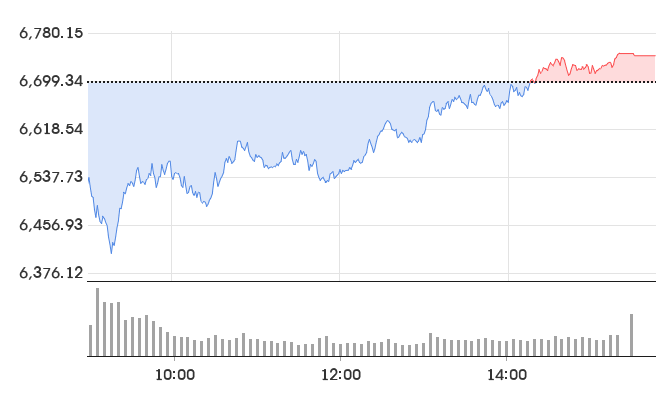
KOSPI daily chart. The August 25 intraday plunge and afternoon recovery play out across the candlestick.
The KOSDAQ followed a similar arc. Opening at 806.93 (-0.79%), it hit a low of 781.89 (-3.87%) before recovering to close at 827.15 (+1.70%). Semiconductor equipment shares drove the rebound.
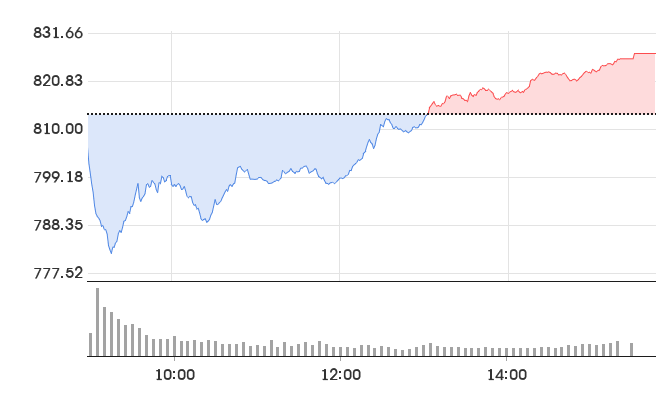
KOSDAQ daily chart. Swings were larger than the KOSPI in both directions.
Where the money went
Investor flows diverged sharply between the two indices. On the KOSPI, retail and institutional investors bought while foreign investors sold. On the KOSDAQ, the pattern reversed: foreign and institutional investors bought while retail investors sold.
| Market | Retail | Institutional | Foreign |
|---|---|---|---|
| KOSPI | +1.0513 trillion KRW | +1.1707 trillion KRW | −3.8195 trillion KRW |
| KOSDAQ | −137.5 billion | +15.6 billion | +133 billion |
Foreign investors dumped 3.8195 trillion KRW on the KOSPI. A third consecutive day of selling. Raw numbers read like an exodus. Yet the index rose. Foreign sales concentrated in Samsung Electronics and SK Hynix. That vacuum was filled by retail and institutional inflows into nuclear, construction, and financial shares.
Futures markets reinforced the move. Institutional investors bought 1,476 contracts of KOSPI 200 futures, with retail and foreign investors selling 1,080 and 357 contracts respectively. Institutional direction aligned across both cash and futures—a signal that afternoon strength was more than a retracement bounce. Three-year government bond futures gained 7 ticks; 10-year futures climbed 15. Treasury yields fell modestly, with 3-year debt at 3.830% and 10-year at 4.320%.
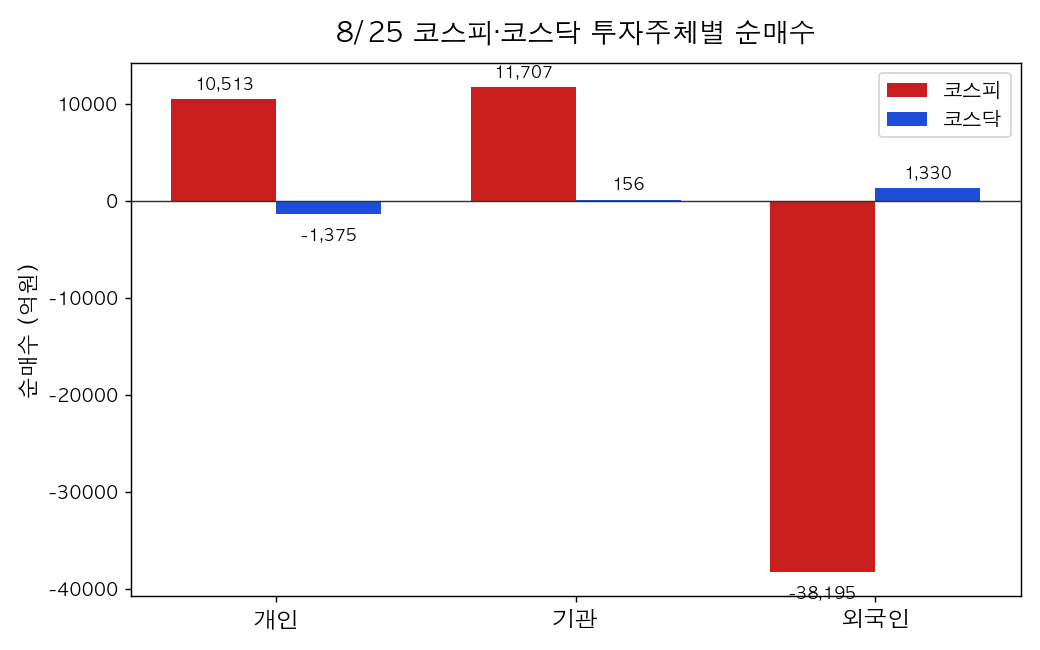
Aug. 25 KOSPI and KOSDAQ investor flows by type (Infostock closing data; units in billions KRW)
Why nuclear and construction stocks surged as one
Doosan Enerbility +10.55%, Korea Electric Power Technology +20.27%, Hyundai Engineering & Construction +14.87%, Daewoo Engineering & Construction +11.80%. The largest concentrated move of the day.
The catalyst was news reporting. The U.S. government proposed joint stake acquisition in Westinghouse Electric to Korea, according to Korean media. Korea Electric Power is reviewing the proposal. The U.S. reportedly extended the offer while cementing partnerships with Canada's Brookfield and Cameco, Westinghouse's major shareholders.
Interpretation requires care. No official announcement exists. Coverage remains single-source reporting. Whether a stake materializes and at what scale remain unsettled. However, KB Securities noted in a report that the U.S. Department of Energy's $17.5 billion supply-chain lending commitment could foreshadow new nuclear initiatives in the second half of the year.
Hanwha also surged, up +17.40%, though for a different reason: first day of changed listing following a corporate spin-off. Its newly listed subsidiary, Hanwha Machinery & Service Holdings, briefly hit its daily limit before paring gains to close in positive territory. First-day volatility was pronounced. The move reflected the spin-off event itself rather than nuclear sentiment alone—attributing the entire gain to thematic exposure would overstate nuclear influence on the wider index.
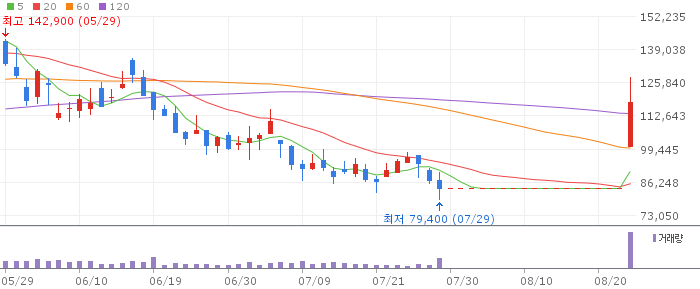
Hanwha daily chart. Surged on first day of changed listing following spin-off restructuring.
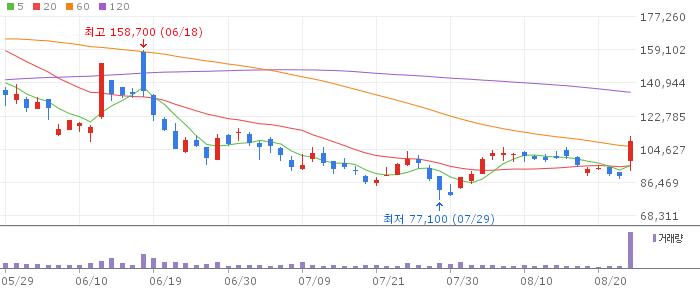
Korea Electric Power Technology daily chart. The largest percentage gainer in the nuclear theme.
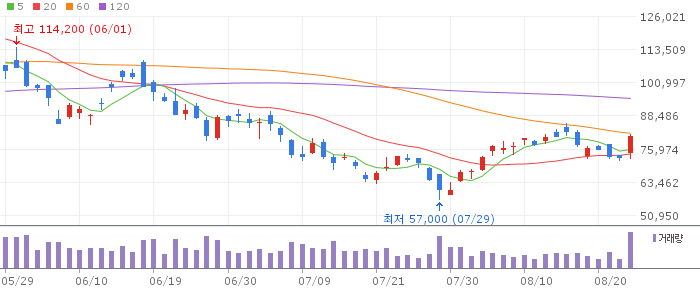
Doosan Enerbility daily chart.
Semiconductors stabilize; biotech weakens throughout
Samsung Electronics closed flat (0.00%), having cratered intraday before recovering. SK Hynix gained 0.42%. Both shares began paring losses precisely when the KOSPI index reversed—correlation that suggests afternoon strength was genuine rather than temporary.
On the KOSDAQ, semiconductor equipment and materials exhibited clear strength. Semtech +11.12%, HPSP +10.35%, Jusung Engineering +7.71%, ISC +7.20%. Optimism over continued industry demand. Large-cap semiconductors shook while equipment and materials held—a signal of capital rotation ahead of earnings into less-expensive names.
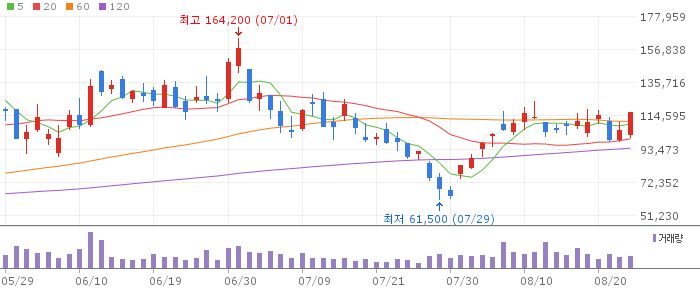
Semtech daily chart. Embodies KOSDAQ semiconductor equipment strength on the day.
Biotech and pharmaceuticals weakened across the board. Alteo Genetics −4.68%, EcoPro BM −3.85%, Rigakhem Bio −3.11%. mRNA, obesity-treatment, and biosimilar themes all suffered. The exception was Shinla Gene, which hit its daily limit after the U.S. FDA designated its cancer drug candidate BAL0891 as an orphan drug for acute myeloid leukemia.
Cryptocurrency-related shares also outperformed on KOSDAQ as bitcoin crossed $80,000. Wuri Technology Investment rose 15.84% while BitPlanet hit its daily limit of +30.00%.
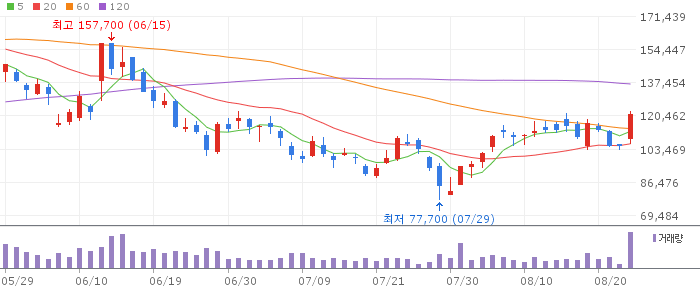
Hyundai Engineering & Construction daily chart. Grouped with nuclear suppliers in afternoon strength.
Three catalysts converge in the days ahead
Today's swings were not random. Three significant events overlap this week.
Nvidia reports second-quarter earnings on August 26 (U.S. Eastern time), or August 27 (early Korea time). Markets will monitor not only guidance but also CoWoS packaging capacity and whether HBM3E and HBM4 supply constraints are easing. Overnight semiconductor selling likely reflected caution ahead of these numbers.
Jackson Hole Economic Symposium resumes, with Federal Reserve officials set to speak. Market interpretation of the interest-rate path may shift by the day, introducing uncertainty into positioning ahead of each statement.
The Bank of Korea's Monetary Policy Committee meets on August 27. Rate-hold consensus is dominant. However, financial-stability concerns persist unresolved. Even if rates remain steady, cautious messaging on future rate cuts may continue.
Three events compressed into two days likely amplified intraday volatility. The market lacks singular conviction, swinging with each headline.
What happens next: numbers to watch
It is too early to draw lasting conclusions from a single day. Foreign investors have sold KOSPI shares for three consecutive sessions—yet the index has risen. This divergence matters. Whether retail and institutional inflows into nuclear and construction continue to absorb foreign outflows, or whether selling resumes and takes the index lower, will become clear over the next few trading days.
Tomorrow is the final session before Nvidia earnings. Watch whether Samsung Electronics and SK Hynix repeat today's pattern—sharp intraday drops followed by late recovery—and whether nuclear-stock strength proves durable or exhausts itself as a one-day rotation.
Related reading
KOSPI drops to 6,696 as Samsung Electronics buyback of 15 trillion KRW fails to prevent decline
KOSPI rises as Dow gains 517 points; why did Korean Treasury yields climb even more
Investment decisions and their outcomes remain your own responsibility.
댓글
댓글 쓰기