On August 21, 2026, the KOSPI Index closed at 6,912.95, up +0.88% from the previous day. But on the same day, KOSDAQ fell to 801.94, down -4.63%, and even triggered a sell-side circuit breaker during the session. On paper, both are Korean markets, but they had completely different days.
Just two stocks pulled KOSPI higher: Samsung Electronics and SK Hynix. What dragged KOSDAQ down were the biotech, secondary battery, and semiconductor equipment stocks that had surged the day before. To understand today, you need to grasp the temperature difference between these two markets first.
KOSPI Takes a Roller Coaster Ride, Closes Higher
KOSPI had a rough start today. Overnight, Wall Street fell on rising Treasury yields, a Middle East-driven oil spike, and concerns about Walmart's weak earnings. KOSPI opened down 1.35% at 6,759.95. In early trading, it dipped as far as -1.61%.
Then a rebound kicked in mid-morning. Around noon it climbed to the 6,940 level, only to slide back to 6,870 in the afternoon, then surge again to 6,954.12. The gap between today's low and high was 211 points—over 3%. It finally settled at 6,912.95, trimming some gains.
Samsung Electronics (+3.87%) and SK Hynix (+2.31%) held the steering wheel through this ride. After SK Hynix announced a record shareholder return plan on the 19th, Samsung Electronics was expected to unveil its own shareholder return measures, including a special dividend, at its board meeting that day. Bloomberg reported the total payout could reach 90–110 trillion won.
Samsung Electronics' three-year shareholder return policy (2024–2026) centers on returning 50% of free cash flow. This year is the final year of that policy. Markets are pricing in a scenario where Samsung loads the final installment.
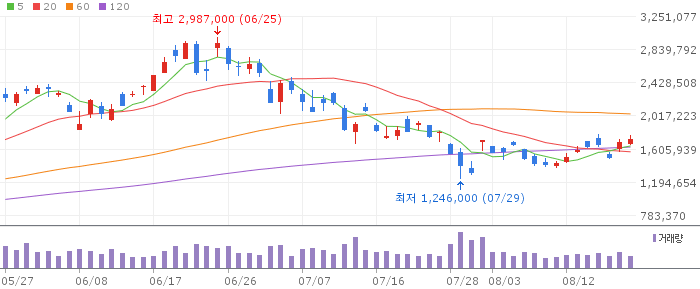
SK Hynix—three-month daily chart (Naver Finance, red=up/blue=down)
But as those two stocks rose, most others fell. Hanwha Aerospace (−7.03%), Samsung Electro-Mechanics (−5.73%), HD Hyundai Heavy Industries (−4.73%), Samsung SDI (−4.30%), LG Energy Solution (−4.05%)—most of the top-tier names dropped. More large-cap names fell than rose, yet the index went up. That shows how outsized the concentration was in those two stocks.
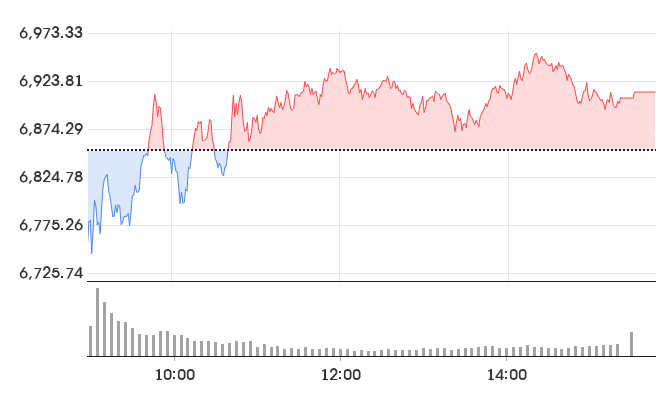
KOSPI Index—recent daily chart (Naver Finance, red=up/blue=down)
Supply and Demand: Institutions Turned Buyers After Five Days
Looking at KOSPI supply and demand, institutions net-bought 248 billion won. That's their first net buy in five trading days. Meanwhile, retail investors net-sold 1.165 trillion won, and foreigners net-sold 170.8 billion won. Retail turned to selling for the second straight day; foreigners reversed after just one day.
Institutions were the driving force behind today's index gain. KOSDAQ told the opposite story. Foreigners net-sold 287.5 billion won, institutions net-sold 346.4 billion won, and only retail net-bought 623.8 billion won. Institutions resumed buying KOSPI but were actually selling KOSDAQ. On the same day, in the same country's market, institutions' eyes were completely split.
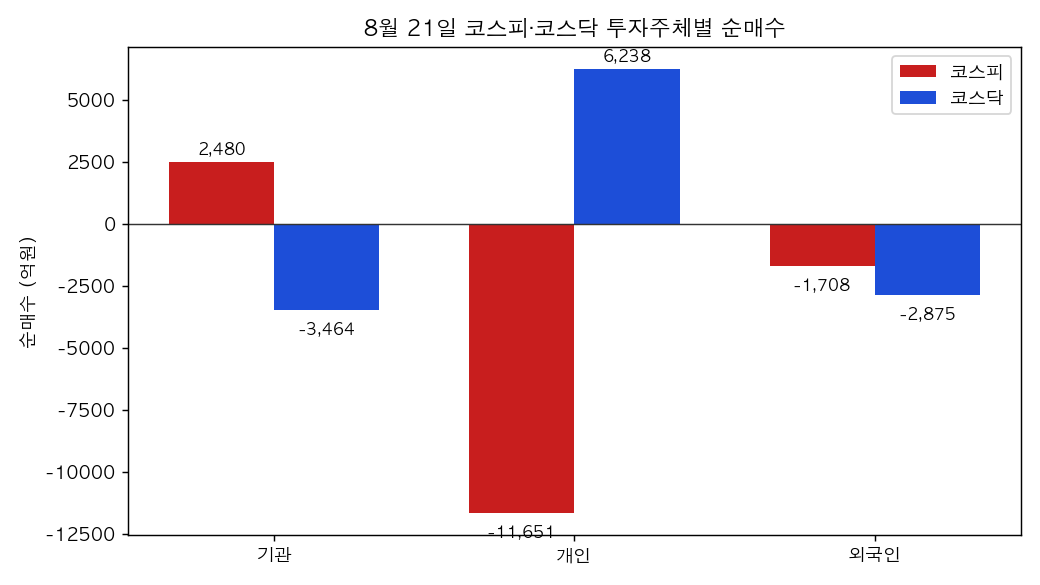
Compiled and charted in-house
Why Did KOSDAQ Trigger a Circuit Breaker?
KOSDAQ opened sharply lower at 824.05, down -2.00%, and losses widened from there. By late morning, it had slid to 795.57, hitting -5.39%, and a sell-side circuit breaker was triggered during the session. That's the 32nd circuit breaker of the year on KOSDAQ, the 14th on the sell side.
A circuit breaker is a safety mechanism that freezes program trading bids for five minutes when futures prices swing sharply. Its activation means heavy selling volume hit in a short window. Eventually the index recovered some losses, closing at 801.94, down -4.63%.
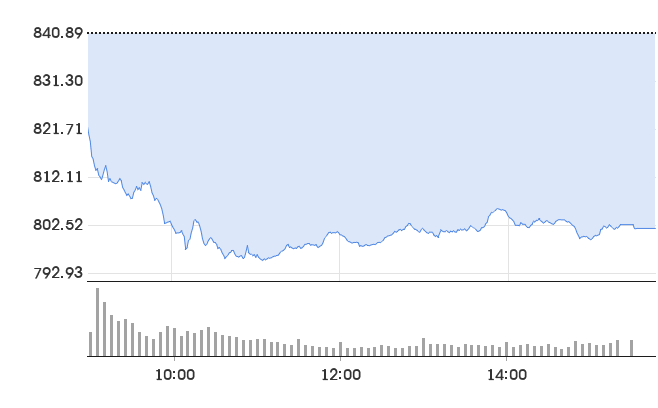
KOSDAQ Index—recent daily chart (Naver Finance, red=up/blue=down)
The selling was led by yesterday's strong performers. Pharma and biotech stocks like Altogen (−5.74%), AbilityBio (−8.85%), Samchundang Pharm (−7.71%), and Ligandchem Bio (−7.66%) reversed to red in a day. Semiconductor equipment makers—JoungShin Engineering (−4.91%), Wonikoip (−5.27%), Linop Industries (−5.47%)—and battery leaders Ecopro (−7.26%) and Ecopro BM (−7.45%) all fell together.
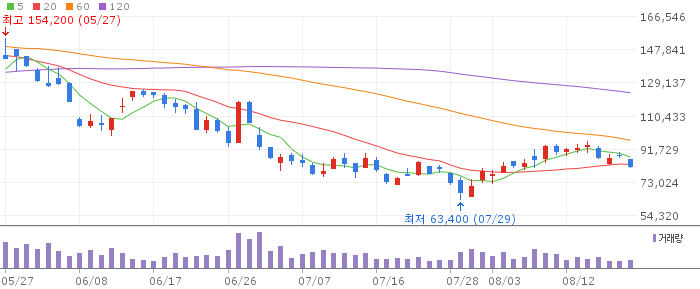
Ecopro—three-month daily chart (Naver Finance, red=up/blue=down)
Particularly notable was Semtech (−13.23%). The semiconductor substrate maker posted the largest loss among top-tier KOSDAQ names. It gave back most of yesterday's gains in a single day.
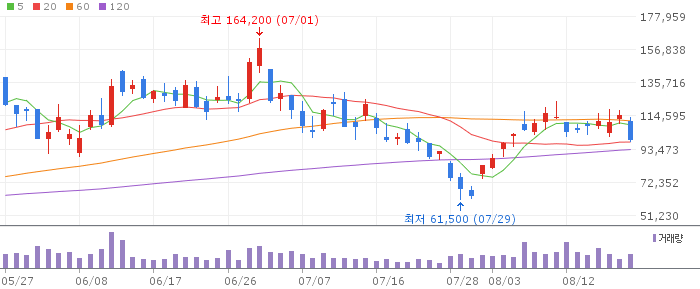
Semtech—three-month daily chart (Naver Finance, red=up/blue=down)
Some Stocks Still Rose—Five Limit-Up Days
Even on a shaky market day, five stocks hit the daily limit up. They're a mixed bag.
NeoImmuneTech (+29.84%) extended a second day of gains on news of a technology transfer deal with U.S. biotech Tolerance Bio. Organic Ti Cosmetics (+29.90%) hit limit-up on a 89.1 billion won third-party placement announcement. Innometry (+29.88%) rode battery inspection equipment shipment news. ParataxisEthereum (+29.96%) and BitPlanet, crypto-related stocks, soared on bitcoin breaking the $70,000 level.
KuCoin (+23.17%) also jumped. In Q2 earnings, its data and payment segment revenue grew 7.3% year-over-year, and it announced Korea's first MCP (Model Context Protocol)–based data API product launch and integration with seven global payment methods. It was a day that showed stocks with solid individual catalysts move independently even when the broader market shakes.
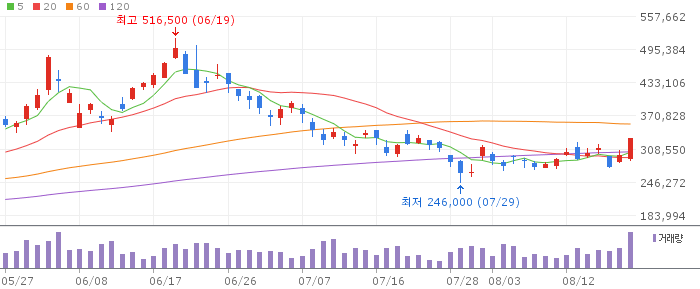
Samsung Life—three-month daily chart (Naver Finance, red=up/blue=down) — up +10.61% on shareholder return hopes
Semiconductor Exports: August 1–20 Already a Record
Beyond index moves, today's export data is worth noting. According to Customs, exports for August 1–20 (preliminary clearance basis) totaled $55.2 billion, up 56.0% year-over-year. That's a record for this period.
Semiconductors are even more striking: $26 billion, up 198.8% from a year ago. That surpassed the prior record of $25.5 billion last June in just two months. Semiconductors now account for 47.2% of total exports, up 22.5 percentage points year-over-year. Nearly half of all exports hinge on semiconductors alone. Today's rally in Samsung Electronics and SK Hynix is underpinned by these numbers.
The Takeaway
Today KOSPI rose on shareholder return hopes tied to two major chip stocks. KOSDAQ plunged as yesterday's buying interest evaporated in a day, even triggering a circuit breaker. It was hard to judge the market as a whole by a single index—there was a wide temperature gap inside the market.
Tomorrow's watch points are Samsung Electronics' actual shareholder return plan announcement and whether KOSDAQ can recover today's losses. Worth monitoring: whether stocks that plummeted like Semtech bounce back, or slide further.
Related earlier posts on similar concentration themes include KOSPI Rebounds to 6,345, Semiconductor Exports Hit Record Highs—But Why Are Shipbuilding and Defense Stocks Down Even More, and on today's drop, Semtech Stock Fell Today—Operating Profit Surged 10x in Q2, So Why the Dip?. They're worth reading for context.
This post is not investment advice. All investment decisions and outcomes are your own responsibility.
#TodaysMarket #KOSPIIndex #KOSDAQ #MarketClose #SamsungElectronicsStock #SKHynixStock #ShareholderReturns #CircuitBreaker #KOSPI #SemiconductorExports #ForeignBuying #InstitutionalBuying #SemtechStock #KuCoinStock #NeoImmuneTech #OrganicTiCosmetics #Innometry #Bitcoin70k #CryptoTheme #SamsungLifeStock #Ecopro #PharmaBiotechTheme #KOSPIOutlook #KoreanMarkets #TodaysStocks #MarketReport #LimitUp #SurgeStocks #InvestmentInfo #StockInvesting
댓글
댓글 쓰기