On the 21st, Kakao's share price plummeted to 34,150 won during trading. That's an 11.76% nosedive from the previous day. Just five trading days earlier, it was at 40,100 won. So we're looking at a near 15% drop in just a week. This morning at 9:54 a.m., it opened down about 6%. Then at 10:04 a.m., trading halted completely. When it resumed 30 minutes later, the decline had widened to double digits. There's only one reason: the company is splitting itself in two through a major governance restructuring.
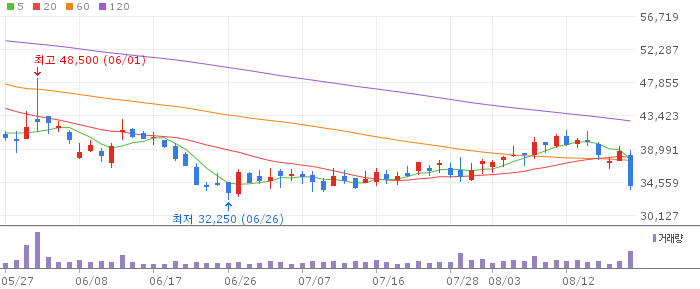
Meanwhile, the KOSPI actually climbed 1.22% that day. So here we had Kakao dropping over 11% on a day when the broader market was rising. This wasn't a market-wide issue—it's squarely a Kakao company story. The subsidiaries felt the tremor too. KakaoPay dropped the hardest at -7.01% (41,800 won). KakaoBank only fell -0.47% (21,100 won). But here's something worth noting: the KOSDAQ plunged 4.82% that day. KakaoGames, a KOSDAQ listing, fell -3.57% (8,650 won). That's actually less than the broader market. So it's tough to say the entire Kakao group was uniformly shaken.
If it's a proportionate split, shouldn't shareholders come out okay?
What Kakao's board approved that day was a proportionate split—dividing the company into two. There are actually two types of splits. An asset split is when the parent company retains 100% of the new company's shares. Individual shareholders get nothing. Your stake gets locked inside the subsidiary—that's what happened with LG Chem's LG Energy Solution split, and retail investors were furious. A proportionate split, though, is different. Existing shareholders receive new company shares in the same ratio they already hold. Say you owned one share of Kakao. You'd end up with shares in both KakaoX (the surviving entity, provisional name) and KakaoAI (the new entity, provisional name). Your stake doesn't vanish. It's more like your one share becomes two pieces of paper.
So why did the stock price fall double digits?
A proportionate split, by definition, shouldn't strip shareholders of their stake. Yet the market reacted this way. There's a reason. When you dig into the disclosed financial statements (as of June 30, 2026), one glaring asymmetry jumps out.
| Classification | KakaoX (Surviving) | KakaoAI (New) |
| Recent Revenue | 202 billion won | 2.6461 trillion won |
| Capital (Net Assets) | 5.0611 trillion won | 2.915 trillion won |
| Split Ratio | 0.6351463 | 0.3648537 |
KakaoAI is taking over the KakaoTalk-based platform business. Its revenue is about 13 times bigger than KakaoX. But here's the kicker: the split ratio that determines how many new shares you get is backwards. The much smaller revenue generator, KakaoX (0.635), gets the bigger slice. Here's why: the split ratio isn't based on revenue—it's based on book value of net assets. KakaoX is sitting on a pile of subsidiary stakes like KakaoBank and KakaoPay as assets. So on paper, it has bigger capital. In other words, the smaller revenue producer gets more shares. This asymmetry is what makes it hard to have confidence that "my share of this is going exactly where and in what proportion." That's become a source of real uncertainty.

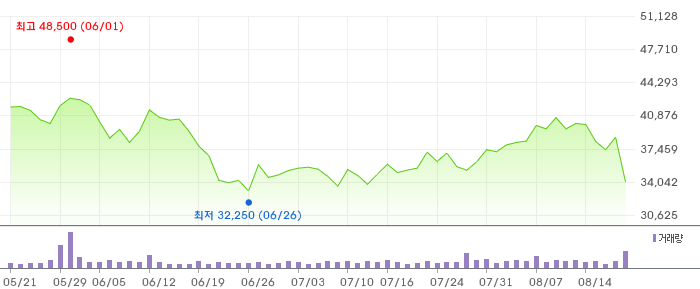
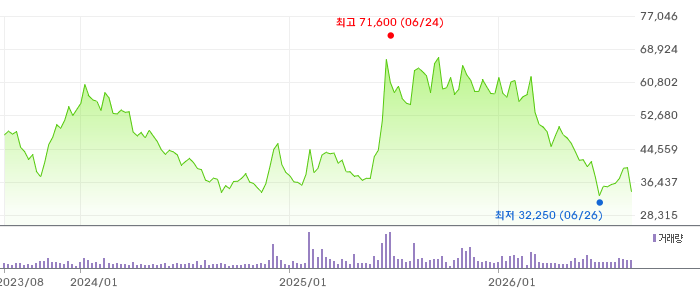
Let's look at the three-month and three-year moves side by side. You'll see why this plunge stands out. On the three-month chart, the price had been drifting gently downward, then on this day it took a sharp step down. On the three-year chart, it's even clearer. This kind of one-day drop is pretty rare in recent years.
For four weeks, you can't buy or sell this stock
There's something more concrete to worry about. According to the disclosure, trading will be halted for about four weeks, from December 30, 2026 to January 26, 2027. You literally can't buy or sell during that window. After an emergency shareholder meeting on December 17, the split date is January 1, 2027, then registration happens on January 4, with the two stocks relisting or changing their listing status on January 27. What the stock prices of the two companies will be after relisting? No one knows yet. On top of that, the original corporate value enhancement plan filing includes this line: "A conglomerate discount arising from the group's diverse business portfolio structure is inevitable." In other words, the company is admitting it's undervalued. But here's the irony: on the very day they announced the fix for that undervaluation (the split), the stock price fell. Paradoxical, right? That said, the filing doesn't spell out how they'll handle treasury shares or whether they plan to convert to a holding company later, so those remain unclear.
Subsidiaries got shaken too
KakaoX will manage subsidiaries including KakaoBank, KakaoPay, KakaoGames, and KakaoMobility going forward. These affiliated companies all wobbled in tandem. KakaoPay took the biggest hit at -7.01%. KakaoGames followed with -3.57%. KakaoBank, which holds a banking license, only dropped -0.47%. It felt relatively lighter. One piece of news—a governance restructuring—moved the entire slate of Kakao's listed subsidiaries in a single day.

By the way, the company's earnings were actually at record highs
Ironically, just two weeks ago on August 6, the company reported Q2 revenue of 2.0985 trillion won and operating profit of 277 billion won (up 36% year-over-year). That's a record quarterly result. Operating margin also improved to the high 13% range. Platform revenue, including TalkBiz, jumped 17%, driving the show. Earnings are clearly improving. But that was only two weeks ago. Now a governance restructuring announcement has sent the stock reeling. You can't really call it good news or bad news in the simple sense. It reads more like a structural-level event shaking the very foundation.
So, where does this stock stand now?
A proportionate split, in principle, shouldn't strip shareholders of their ownership. Yet the stock dropped double digits. There are three reasons: the split ratio is backwards to revenue scale (that asymmetry), a four-week trading halt, and the company's own admission of a conglomerate discount. All three hit at once. This is the window of maximum uncertainty. We still can't know whether this restructuring will actually unlock value in each company.
The watch point is singular: Will the December 17 emergency shareholder meeting approve this split plan as is? And secondly, will the company flesh out more concrete shareholder return plans—treasury shares, dividends, that sort of thing? We have until early January next year, when trading completely freezes for four weeks. This stock has entered an uncommon phase where structure moves before numbers.
This piece is written for informational purposes to support investment decisions and does not recommend buying or selling any specific stock.
#Kakao #035720 #KakaoStockPrice #FeatureStock #ProportionateSplit #KakaoX #KakaoAI #GovernanceRestructuring #KakaoPay #KakaoBank #KakaoGames #TradingHalt #CorporateValueEnhancementPlan #ConglomeratDiscount #SplitRatio #Q2Earnings #PlatformStock #KOSPI #StockInvestment #DARTFiling
댓글
댓글 쓰기