On August 18, 2026, KOSPI closed at 6,869.83, down 1.55%. But if you just look at that number, you're missing half the story of today's market. KOSPI opened at 7,127.77 and soared to 7,216.62 mid-morning (up 3.42% from the previous close), then got hammered down to 6,788.78 in the afternoon—a real roller coaster. Between peak and trough for the day, we saw 428 points swing.
What really stands out is the trading flow. Institutions alone pulled the index down today. Foreigners kept up their net buying streak for the fifth consecutive day, and individuals also returned to net buying after five days. When only institutions are selling yet the index still drops 1.55%, it tells you how heavy the institutional selling pressure was.
Index and Trading Flow—Institutions Sold for Two Straight Days
KOSPI fell 108.11 points to 6,869.83 (down 1.55%), marking its first drop in six trading days. KOSDAQ fell harder, dropping 30.45 points to 834.20 (down 3.52%). KOSDAQ also started strong in the morning, climbing to 872.59, before getting hit down to 827.97 in the afternoon and then recovering some of those losses at the close. The interesting thing about today's market is that both indices followed the exact same pattern—strong rally to start, sharp decline in the afternoon, partial recovery into the close.
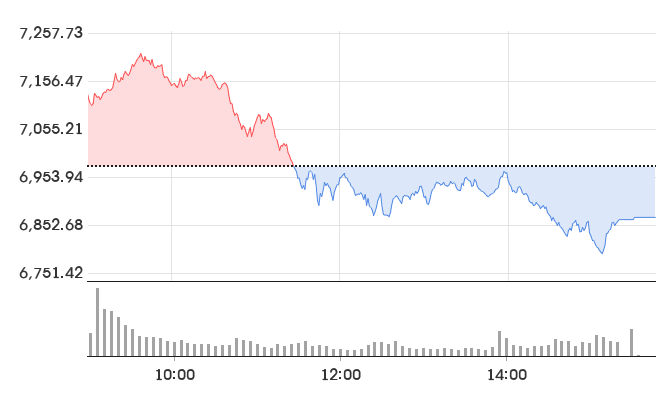
KOSPI Daily Chart (Naver Finance)
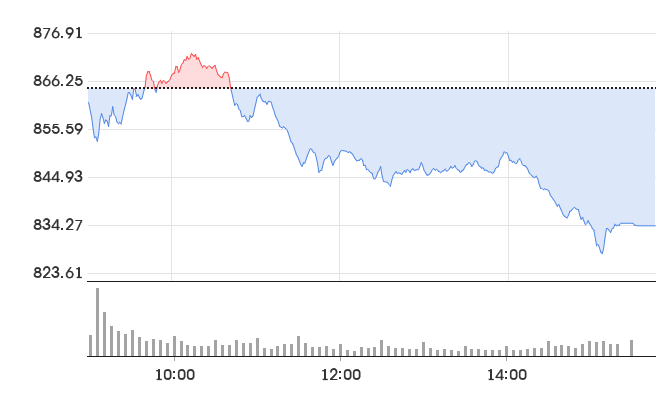
KOSDAQ Daily Chart (Naver Finance)
Breaking down by investor type: institutions net sold ₩795.1 billion on KOSPI while individuals and foreigners net bought ₩741.5 billion and ₩86.1 billion, respectively. On KOSDAQ, institutions net sold ₩416.4 billion while individuals and foreigners net bought ₩389.2 billion and ₩36.8 billion. This was KOSPI's second straight day of net institutional selling and KOSDAQ's fifth. Days where buyers (individuals and foreigners) and sellers (institutions) line up this clearly are pretty rare.
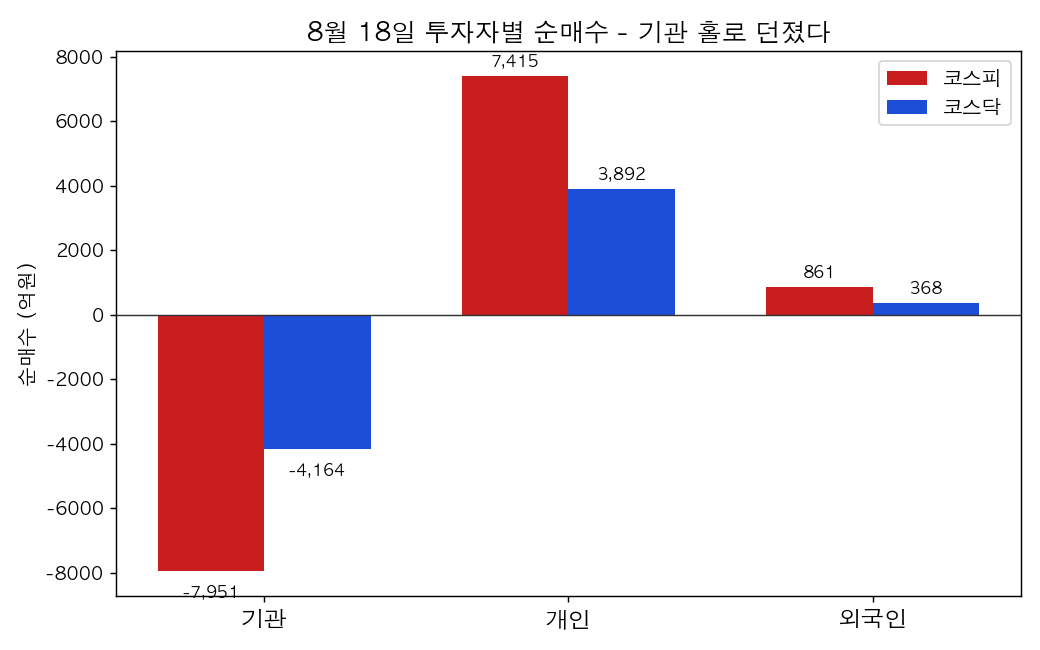
Direct Collection & Analysis
We don't have a clear official reason why institutions sold so aggressively today, but given that KOSPI just surged, profit-taking on the institutional side seems likely. Looking back at 12 years of price data, whenever the index has jumped sharply and then institutions flip to net selling for two days straight, we've typically seen volatility spike for the next one to two weeks. Whether we're seeing that same pattern this time will depend on what the flows look like over the next few days.
Winners—Earnings and Inter-Korean Issues Drove Different Stocks
In a day when most sectors fell, the stocks that rose did so for two main reasons. One was second-quarter earnings results, and the other was President Trump's comment that he'd respond positively to North Korea's Kim Jong-un requesting U.S.-North Korea talks.
Duborn Korea (475560) jumped 21.84%. The catalyst was news of partnership agreements with Canadian hotel and real estate companies and plans to locally produce Hong Kong Banjjang sauce in the U.S. However, Q2 earnings released on the 14th showed revenue of ₩83.2 billion (up 12.17%) but an operating loss of ₩5.56 billion—losses continue. Since optimism about overseas expansion is overshadowing weak earnings, it'll be worth watching whether this rally translates into actual profit improvements next quarter.
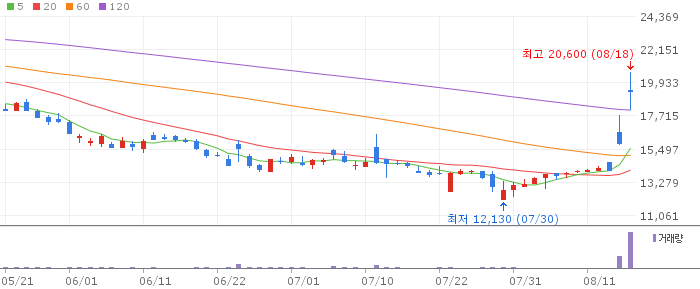
Duborn Korea Recent 3-Month Daily Chart (Naver Finance, Red=Up/Blue=Down)
That one Trump comment sent inter-Korean cooperation stocks soaring—Good People (+30.00%), Codes Combine (+30.00%), JS Tina (+16.40%) and others all hit the daily limit or surged. Shipping and energy themes also rallied as tensions in the Strait of Hormuz flared again, with STX Green Logistics (465770) hitting the daily limit up at +29.91%. The U.S.-Iran ceasefire memorandum expired without a final deal and Trump refused to extend it, sparking concerns about disruptions to crude oil shipping routes and pushing both oil prices and shipping costs higher.
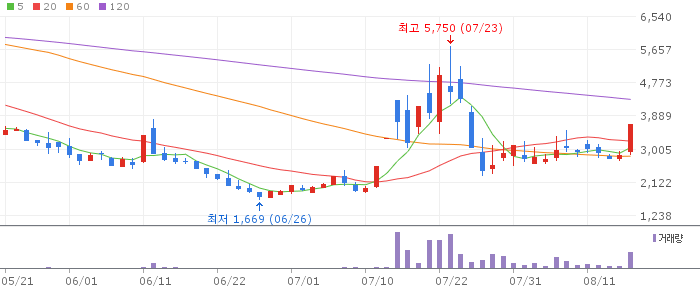
STX Green Logistics Recent 3-Month Daily Chart (Naver Finance, Red=Up/Blue=Down)
Both themes share one thing in common—they're event-driven rallies riding on news. Whether inter-Korean cooperation keeps going depends on whether Trump's comment proves real and what follow-up actions happen. Whether shipping and energy rallies stick depends on how the Strait of Hormuz situation actually plays out.
Losers—The Sectors That Led Recently Got Hit Hardest
The sectors taking the biggest hits today are mostly the ones that led the market over recent months. Samsung Electro-Mechanics (009150) fell 7.57%, posting the steepest decline among MLCC plays. Battery giants also got hammered—LG Energy Solution (−5.01%), Samsung SDI (−5.43%), Ecopro BYD (−6.51%), Ecopro (−6.94%). Autos like Hyundai Motor (−3.97%) and Kia (−3.18%), internet darlings like NAVER (−4.82%) and Kakao (−4.38%), and brokers like KB Securities (−5.66%) and NH Investment (−4.35%) all took hits.
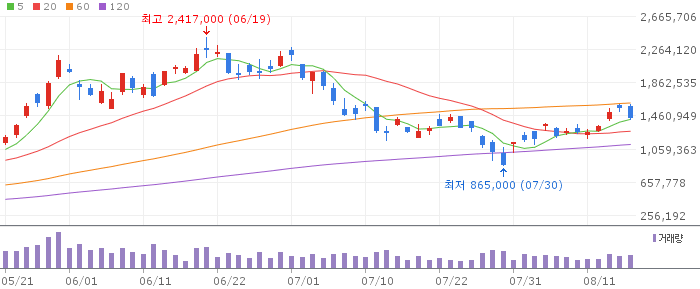
Samsung Electro-Mechanics Recent 3-Month Daily Chart (Naver Finance, Red=Up/Blue=Down)
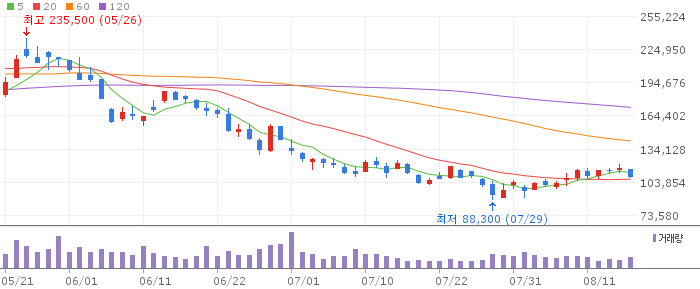
Ecopro BYD Recent 3-Month Daily Chart (Naver Finance, Red=Up/Blue=Down)
By contrast, Samsung Electronics (−2.19%) actually held up pretty well, and SK Hynix (+1.03%) even rose. Strong semiconductor export momentum and a rally in the Philadelphia Semiconductor Index helped. It's a great example of how even among mega-cap tech stocks, the temperature between semiconductors and batteries or autos can be completely different.
Today's Core Issue—Oil and Interest Rates Jumped Together
| Issue | Details |
|---|---|
| Strait of Hormuz Tensions | U.S.-Iran ceasefire memorandum 60-day deadline expires; Trump refuses to extend |
| U.S. Treasury Yields | 30-year at 5.310%, highest since 2007; 10-year at 4.725% |
| July Trade | Exports $99.0 billion (+63.0%); Semiconductor exports $41.17 billion (+176.3%) |
Iran, facing diplomatic deadlock, warned of expanded military action, which dimmed prospects of a quick normalization in the Strait of Hormuz. On the heels of that, global oil prices shot up. At the same time, U.S. Treasury yields kept climbing, with the 30-year hitting its highest level since 2007. When oil and rates both rise together, it's a tough combo for stocks. Rising oil stokes inflation, while rising rates hit valuations. Both of those probably worked together to explain why KOSPI gave back its morning gains.
There was some good news too. July exports hit $99.0 billion, up 63.0% year-over-year, and semiconductor exports surged 176.3% to $41.17 billion, marking the second straight month above $40 billion. The trade surplus came to $30.4 billion, extending the winning streak to 18 straight months. Still, since these strong numbers had pretty much already been priced in, they didn't do much to prop up the index today.
Takeaway—What to Watch Tomorrow
Today comes down to two things. First, volatility spiked—we saw 428 points swing between high and low in a single day. Second, even amid that volatility, foreigners and individuals were buying while only institutions were selling. Tomorrow, watch whether institutions extend their net selling streak to a third day, and whether the U.S. and Iran dig in their heels harder over the Strait of Hormuz. If oil and rates keep rising together, we might see today's pattern repeat—strong morning, weak afternoon.
In a recent post about KOSPI falling a day before the market reopened after the holiday as New York Treasury rates hit 5.31%, I noted how rising U.S. long-term yields weigh on the Korean market—and that same dynamic played out today. If you want more color on why Duborn Korea surged today, check that out too.
This article is for informational purposes only; investment decisions and outcomes are your responsibility.
#TodaysMarket #KOSPI #KOSDAQ #KOSPIIndex #KOSDAQIndex #MarketClose #ForeignerNetBuying #InstitutionNetSelling #StraitofHormuz #CrudeOilPrices #USBondYields #InterKoreanCooperation #DubornKorea #STXGreenLogistics #SamsungElectroMechanics #EcoproBYD #SemiconductorExports #DailyLimitUp #FeaturedStocks #DomesticMarket #StockInvesting #MarketUpdate #InvestmentInfo #StockOutlook #TodaysMarket #MarketSummary #ClosingUpdate #InvestmentSentiment #IntradayVolatility #KOSPIOutlook
댓글
댓글 쓰기