Today is Tuesday, August 18th. The KOSPI closed at 6,977.94 last Friday (August 14th) with five consecutive days of gains, then took a day off yesterday, August 17th, for a temporary public holiday. But New York wasn't quiet during that single day off. The Dow Jones, S&P 500, and Nasdaq all declined together, and the 30-year U.S. Treasury yield climbed to 5.31%, the highest since June 2007. The culprit was the Middle East again. The U.S.-Iran Memorandum of Understanding (MOU) expired, crude oil prices surged, and inflation concerns from this oil spike shook the bond market. The domestic market has to digest this change that happened while we were off in just one trading day today.
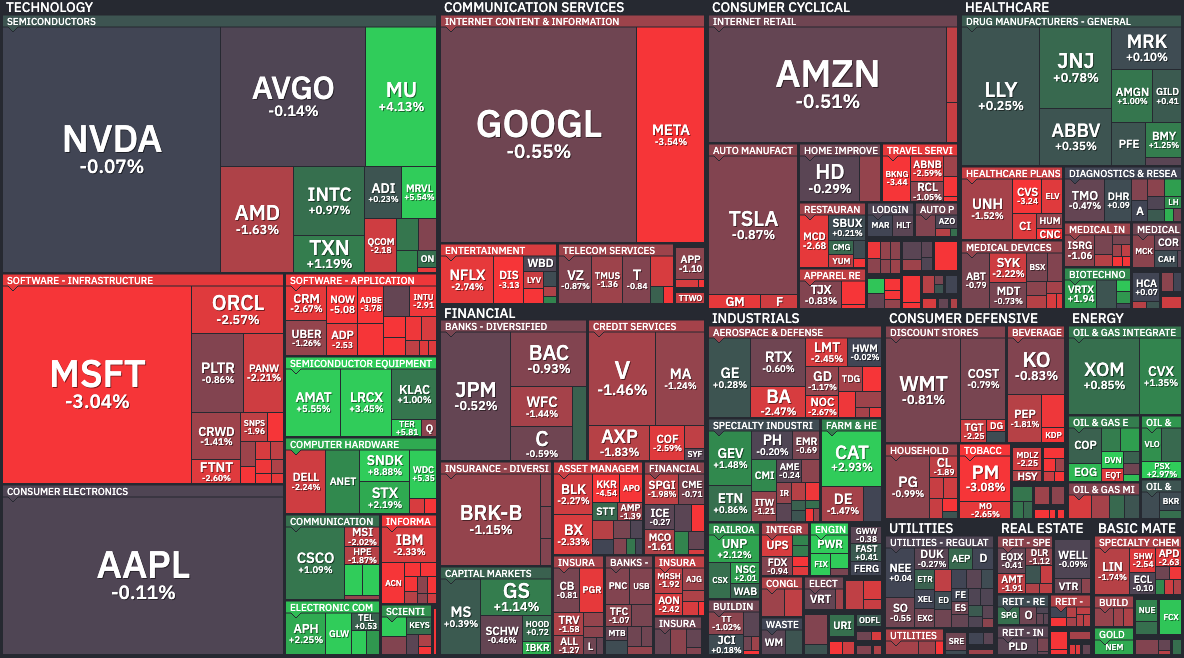
U.S. market map from last night (S&P 500 heatmap) · Green = up / Red = down (finviz U.S. color scheme)
To cut to the chase, yesterday's NYSE decline (August 17th, Monday local time) wasn't about earnings or economic data—it was purely a geopolitical variable. With oil prices rising, inflation re-emergence concerns grew, and Treasury yields jumped, pushing stocks down in a typical pattern. For Korean semiconductor and export stocks, it's a complex situation with both crude oil and rate headwinds, plus the individual strength of still-solid memory stocks.
The U.S. Three Major Indexes Closed—Why They All Fell Together
Wall Street last night · All three major indexes fell together due to geopolitical variables
On August 17th (local time), the NYSE saw the Dow Jones down 0.51% (down 272.63 points, closing at 53,459.78), S&P 500 down 0.52% (down 40.70 points, closing at 7,745.06), and Nasdaq Composite down 0.32% (down 84.25 points, closing at 26,644.91), with all three major indexes declining. This is a correction that came just two days after the S&P 500 reached a record high last Friday.
The direct trigger for the decline was the expiration of the U.S.-Iran Memorandum of Understanding (MOU). President Trump said "the war doesn't seem to be ending anytime soon," and even mentioned the possibility of military action against Oman related to interference with the Strait of Hormuz. Following this comment, crude oil prices surged and risk-off sentiment strengthened. The VIX, the volatility index, jumped 6.60% in a single day to 15.19. While the absolute level remains low, the magnitude of the increase can be seen as a signal that the market is beginning to tense up.
| Index | Close | Change |
|---|---|---|
| Dow Jones | 53,459.78 | -0.51% |
| S&P 500 | 7,745.06 | -0.52% |
| Nasdaq Composite | 26,644.91 | -0.32% |
| VIX (Volatility Index) | 15.19 | +6.60% |
Why Did Semiconductors Move Differently Than the Market?
Semiconductor wafer production line · The overall market fell, but memory stocks held steady
The exact closing price for the Philadelphia Semiconductor Index (SOX) wasn't available in this data. However, the individual stock movements were clear. Even though the overall market fell, memory-related stocks held steady, with Micron up 2.9% and SanDisk surging 3.7%. Broadcom also rose slightly, and there were reports that NVIDIA showed strength during the session. This can be interpreted to mean that the AI infrastructure investment expectations that continued last week remained alive even amid geopolitical variables.
This point matters for the domestic market. It was memory megacaps like SK Hynix (+3.26%) and Samsung Electronics (+2.43%) that led the KOSPI's rise last Friday. The fact that memory stocks moved differently from the overall market last night leaves open the possibility that today's domestic semiconductor megacaps could move closer to individual stock trends (steady) rather than the overall index direction (down). However, the specific price changes for TSMC, Micron, and SK Hynix ADRs couldn't be confirmed in this data. I'll cover them as soon as they're confirmed.
Interest Rates, Exchange Rates, and Crude Oil—Signals Coming to the Domestic Market

International crude oil prices surged amid a sharp drop in Strait of Hormuz traffic
The core reason for this decline is the bond market. The 30-year U.S. Treasury yield rose 5 basis points to 5.31%, recording its highest level since June 2007. The 10-year yield also rose together. Concerns about the burden of national debt seem to be reflected in long-dated securities first. By Chicago Mercantile Exchange FedWatch criteria, the market's expectations around the September rate decision remain intact, but when long-term rates jump like this, pressure for funds to flow into bonds rather than stocks intensifies.
International crude oil prices surged sharply. WTI rose 3.09% to $84.95 per barrel, and Brent oil climbed to the $90 per barrel level. The backdrop is the expiration of the U.S.-Iran MOU and a sharp drop in Strait of Hormuz traffic. Last Saturday, only 5 cargo ships transited the strait, and on Sunday, not a single ship passed through—a substantial contraction compared to 31 ships that passed the previous weekend. When combined with President Trump's remarks about possible military action related to Oman, concerns about supply disruptions came front and center. This week, major retailers like Walmart, Target, Home Depot, and Lowe's are scheduled to report earnings, so it's worth watching how the price pressures from crude oil translate into consumption indicators.
The specific dollar-won exchange rate figure from last night isn't available in this data. However, it's worth noting that when rising U.S. long-term rates and surging crude oil prices coincide, safe-asset preferences typically strengthen, which often creates headwinds for the won. For reference, the dollar-won exchange rate on last Friday (August 14th) was 1,418.3 won.
While the Domestic Market Rested, Japanese Stocks Rose

The Nikkei Index rose on its own, buoyed by semiconductor stock strength
While the KOSPI was on holiday yesterday (August 17th), the Nikkei Index closed up 0.74% at 69,220.25. Kioxia Holdings led the index gain with a surge exceeding 15%, which reflects the same context as the individual strength of memory semiconductor stocks we noted earlier. While the overall U.S. market fell due to crude oil and rate headwinds, memory-related stocks showed simultaneous strength in both the U.S. and Japan. The closing figures for the Shanghai Composite and Taiwan Weighted Index from yesterday aren't available in this data.
Today's Key Watch Points for the Domestic Market
After a one-day break, the KOSPI will reflect three trading days' worth of overseas variables all at once today
The KOSPI rose for five consecutive trading days, closing at 6,977.94 last Friday, then took a day off. Meanwhile, New York declined due to geopolitical risks, while memory semiconductors held steady in both the U.S. and Japan. With these conflicting signals needing to be absorbed in a single trading day, there are several things worth watching.
First, semiconductor megacaps. Samsung Electronics and SK Hynix were the drivers of last week's gains, and with memory stocks' individual strength reconfirmed last night, it's worth watching whether they move differently from the overall index decline sentiment. Second, the impact of the oil price surge. While refining and chemical sectors could see expectations for improved refining margins, aviation and shipping could face the opposite direction due to cost pressures, so there's potential for cross-industry divergence. Third, the rise in long-term interest rates. The fact that 30-year rates hit their highest level in 19 years could be favorable for financial stocks like banks and insurance companies, but it could be a headwind for interest-rate-sensitive construction and real estate-related stocks.
Additionally, this week features major U.S. retailer earnings reports, which should provide material to gauge the extent to which the oil price surge creates a burden on the real economy through consumption indicators. However, how these factors will actually be reflected in today's domestic market can only be confirmed once the market opens. Given that today is a day to digest three trading days' worth of overseas variables all at once, it's worth keeping in mind that the direction could swing more sharply than usual.
Summary
While the KOSPI took a day off, New York saw all three major indexes decline due to two variables: crude oil surging from the U.S.-Iran MOU expiration and 30-year Treasury yields hitting their highest level in 19 years. However, even within that, memory stocks like Micron and SanDisk, as well as Japan's Kioxia, actually held strong. Since the KOSPI will reflect all these conflicting signals at once today, it's worth watching both the direction of semiconductor megacaps and how different sectors respond to crude oil and interest rate movements.
This article is provided for informational purposes and does not recommend buying or selling any specific stock. Your investment decisions and their consequences are your own responsibility.
#NYSE #KOSPIIndex #USMarketClose #S&P500 #NasdaqIndex #DowJones #InternationalCrudeOil #WTI #BrentOil #USTreasury #30YearTreasury #StraitofHormuz #DollarWon #Semiconductors #SKHynix #SamsungElectronics #Micron #SanDisk #NikkeiIndex #Kioxia #KOSPIOutlook #TodaysMarket #HolidayMarketTrade #RateIncreaseWorries #CrudeOilSurge #RetailEarnings #VIXIndex #MarketAnalysis #InvestmentInfo #StockMarket
댓글
댓글 쓰기