[Focus Stock] Oracle Surges 5.7%, But What Really Caught Market's Attention Was the Layoff News—Not That $638 Trillion Won Backlog
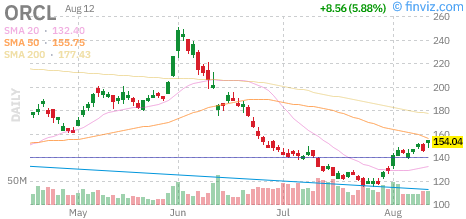
Oracle's stock jumped 5.7~5.9% in trading on the 12th (local time), climbing to around $153~154. For a stock that's still down nearly 28% since the start of the year to jump this much in a single day wasn't due to earnings—or a major new contract announcement. When restructuring news and that massive backlog landed together, the market read it as a single signal: 'There's a ton of money to spend, but now they're finally tightening their belt.'
So why today, and why 5%+?
The trigger for this rally was Oracle's announcement of selective workforce reductions. When they said they'd trim some departments to protect profitability, Wall Street took it as a signal that eased worries about "burning cash before earning it." Add in the confirmation of that $638 trillion won (roughly $460 billion) backlog from their cloud infrastructure business (OCI), and relief flooded in: 'That future revenue already on the books is real.' That backlog is up 363% year-over-year—and it absolutely dwarfs Oracle's annual revenue.
Cross-checking multiple news sources, I found that just days ago on July 30th, Oracle's stock jumped 8%+ in a single day on news of an expanded Gemini partnership with Google Cloud. The idea is embedding Google's AI models into Oracle's enterprise software (Fusion Apps, NetSuite), and since then, bargain-hunting demand keeps flowing in riding this wave. In other words, today's surge isn't a one-off event—it's an extension of the rally that's been running since July's lows.
How far did it fall before bouncing back?
The numbers make this rebound feel even more significant. Oracle hit an all-time high of $345.72 back on September 10th last year, then crashed 57% to July's low of $114.50 this year. Market turned its back when AI data center spending pressures collided with cash flow worries. At $154 now, it's up over 30% from that low, but still down about 28% since year-start. Put another way, today's surge is less about 'recovery to old highs' and more 'filling in half of what it lost from the bottom.'
Analyst sentiment remains quite bullish. The consensus among 44 brokers is Buy, with 12-month targets clustering around $247~253. That's 60%+ higher than current levels—which aligns with the market's view that it's not overpriced, just depressed by cash flow anxiety. In fact, with expected revenue and EPS growth averaging 39% and 30% respectively through fiscal 2029, some argue that the current ~22x P/E on this year's expected earnings looks cheap.
But why has it stayed beaten down until now—the real risks
The backlog being solid hasn't translated to stock recovery because the cash isn't flowing in yet. Oracle posted negative free cash flow of $23.7 billion last fiscal year. Translation: They're spending way more on building AI data centers than they're bringing in. Next fiscal year, capex could balloon to as much as $95 billion. Customers will pay back $20~25 billion of that, but Oracle's got to find the other $40 billion through debt and equity.
Credit rating agency S&P downgraded Oracle to BBB- (one notch above junk status) last July. Data center lease commitments hit around $260 billion, and total debt has ballooned to roughly $130 billion. To make matters worse, their contracts with OpenAI alone exceed $300 billion. That means a huge chunk of future revenue is riding on one customer—so if their business stumbles, Oracle's backlog could wobble too.
Oracle's position among the cloud 'big three'
Oracle's playbook as a late entrant into a market already dominated by Amazon (AWS), Microsoft (Azure), and Google? Keep your friends close—and your competitors closer. Their multi-cloud strategy—letting competitors' clouds run Oracle databases on top—is the textbook example. The Gemini deal with Google fits the same playbook. Instead of competing in LLMs, Oracle picked the role of 'taking the database that 97% of the Fortune 100 already use and gluing in someone else's AI.' Instead of losing the AI arms race, they're betting on being the data infrastructure hub—and we'll see if that call pays off.
So here's the bottom line
Right now, Oracle's basically a 'got the orders, can't make the cash' company. Today's pop wasn't about completely resolving that anxiety—it's more the market giving a thumbs-up to Oracle showing 'discipline on costs' by cutting headcount. That $638 trillion won backlog is absolutely real, but the speed at which they convert it to actual cash? That's the real variable moving Oracle's stock.
The key thing to watch boils down to one metric: Does the free cash flow deficit shrink next quarter? If the deficit narrows, today's rally becomes proof of a 'real breakout'—but if it widens, that $638 trillion backlog could stay just a pretty picture on paper. Whether this stock—down 57%, now up 30%—can really get past its money problems is worth checking when they report next.
This is a U.S.-listed stock, and this is factual analysis—not investment advice. Investment decisions and outcomes are on you.
#Oracle #ORCL #OracleStock #USStocks #USMarkets #Cloud #OracleCloud #GoogleCloud #Gemini #AIInfrastructure #Nasdaq #NewYork #FocusStock #Surge #Earnings #Backlog #CreditRating #FreeCashFlow #LarryEllison #InvestmentInfo
댓글
댓글 쓰기