Micron (MU) stock took a sharp dive to $934.20, down -7.66% from the previous day. Just the day before on August 17th, it had soared to $1,011.75, marking the first time since July that this stock broke through the $1,000 mark. So basically, we watched it hit $1,000 and then fall back to the $900s in a matter of days—and this is the market's hottest stock this year, already up over 240%. Let me dig into why the day's biggest winner suddenly became its biggest loser.
This stock had risen for 5 straight trading days before breaking through $1,000.
To understand this crash, I need to first look at what happened just before. Micron rose for 5 consecutive trading days from August 11th through August 17th. Two main catalysts drove that rally. First, there were reports that the Trump administration was discouraging Apple from using Chinese-made memory chips (Changxin Memory/YMTC). When it came out that Commerce Secretary Howard Lutnick had directly told Apple that he opposed major U.S. companies buying Chinese memory, hopes soared that Micron—America's biggest memory producer—would benefit from the shift. Second, analysts at Newsstreet and UBS raised their price targets based on accelerating AI-driven memory demand. Add to that forecasts of continued memory shortages for AI servers, and you've got the perfect storm of positive sentiment.
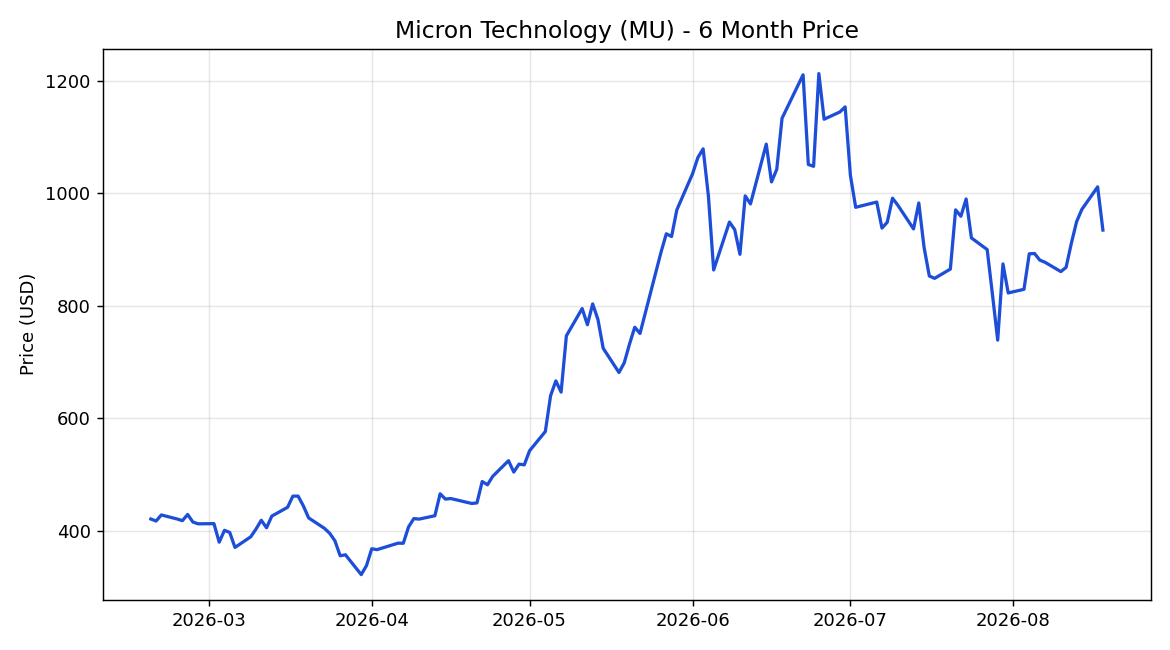
Here's the problem: stocks that shoot up this fast over such a short period tend to stumble at the slightest bit of bad news. That August 17th close of $1,011.75 was more than 12% higher than the August 11th low (around $899)—all in less than 10 days. When it hit the psychological barrier of $1,000, profit-taking kicked in hard, and then two more company-specific headwinds piled on, amplifying the selloff.
A patent lawsuit just dropped—Netlist filed against Micron at the ITC
On August 12th, memory module maker Netlist filed a new patent infringement lawsuit against Micron, SuperMicro, HPE, and Lenovo with the U.S. International Trade Commission (ITC). The claim alleges violations of four patents related to DDR5 RDIMM and MRDIMM technology, and they also filed a separate suit in California federal court. ITC cases typically wrap up within a year, and if Micron loses, the ruling could include an exclusion order preventing related products from being imported or sold in the U.S.—that's a serious risk. Netlist has a history of filing similar lawsuits against Samsung and SK Hynix, so the outcome isn't set in stone, but this suddenly introduced a real risk factor into what had been a purely optimistic "memory supercycle" narrative.
A warning also emerged that "the memory boom is approaching its peak"
Right around the same time, Citigroup analyst Atif Malik kept a buy rating on Micron but lowered the price target from $1,400 to $1,150. The reasoning: memory prices could peak around the second quarter of next year and growth might lose steam. Specifically, he flagged China's expanding memory production capacity as the biggest long-term risk. Of course, there's pushback too. JPMorgan thinks memory supply shortages could persist for another two years, and some analysts are bullish enough to suggest Micron could hit a $1 trillion market cap in this cycle. But the mere fact that people are starting to talk about a "peak" signals that a lot of optimism has already been priced into a stock that's up over 240%.
Will the Apple conflict really be a win for Micron?
The Apple-China chip dispute—which was central to this rally—deserves a balanced view too. If Apple abandons Chinese memory and shifts back to U.S. and allied suppliers, that would definitely favor Micron. But this is still an evolving policy that isn't finalized, and there's a valid counterargument: if Apple can't use Chinese memory, component costs rise, which could push consumer prices higher—not exactly a win for them. That's why we keep seeing reports that Tim Cook, Apple's CEO, is still petitioning for permission to use Chinese memory. In other words, don't assume this conflict will play out entirely in Micron's favor.

So where does Micron stand now?
Right now, Micron feels like "the year's hottest stock taking its first real breather." The underlying AI-driven memory demand hasn't dried up; rather, a price that jumped 12%+ in 10 days ran straight into a $1,000 wall, and then got hit by a one-two-three punch of profit-taking, a patent lawsuit, and peak warnings all at once. There's no sign yet that the company's fundamentals have actually cracked.
One thing to watch: the next quarter's earnings report on September 22nd and whether management's memory price guidance stays bullish. Analysts expect earnings per share this quarter to hit $31.29—roughly 10 times the $3.03 from a year ago—but whether that number materializes and what forward guidance looks like will be the tiebreaker between the "peak warning" camp and the "supercycle" camp. If you watched a 240% gainer get pounded 7% in a single day, you know you should brace for volatility and keep watching until that earnings call.
This is a U.S.-listed stock, and this piece is factual analysis, not investment advice. Investment decisions and outcomes are your own responsibility.
#Micron #MicronStock #MU #USStocks #SemiconductorStocks #AIChips #MemoryChips #DDR5 #HBM #Netlist #PatentLawsuit #Apple #TrumpAdministration #Citigroup #PriceTarget #Nasdaq #USStockInvesting #InternationalStocks #SemiconductorInvesting #EarningsReport
댓글
댓글 쓰기