Thinking about a Japan trip, I checked the yen rate—and the yen is really the only cheap currency right now
Actually, this piece started when I was preparing for a trip to Japan. I was looking at the exchange rate to convert some yen—and wait, the yen has dropped way more than I expected. At 887 won per 100 yen, it's definitely come down from a few years ago. Since I'm already saving on travel costs, I thought, "Should I pick some up now?" So while I was at it, I decided to really dig into where the major currencies stand right now.

Here's the context. The won-dollar rate dropped from 1,558 won in early July to 1,412 won on August 11—a sharp 9% decline in just a month and a half. That means the won strengthened rapidly, which makes foreign currencies look generally weak across the board. But "cheap" means something totally different depending on which currency we're talking about.
Over just the last six months, they all look cheap, but—
If you compare them to the won over six months and year-to-date, here's what you get:
| Currency | Current (won) | 6-month | Year-to-date |
|---|---|---|---|
| Euro | 1,630 | -5.7% | -3.8% |
| Yen (100 yen) | 887 | -6.2% | -3.7% |
| Dollar | 1,412 | -5.7% | +1.6% (1yr) |
| Swiss franc | 1,743 | -7.9% | -4.3% |
Over six months, they all look weak. But that's mostly an optical illusion from the won's recent spike. Stretch the timeframe out and the picture changes.
When you look at one to five years, there really aren't many that are actually cheap
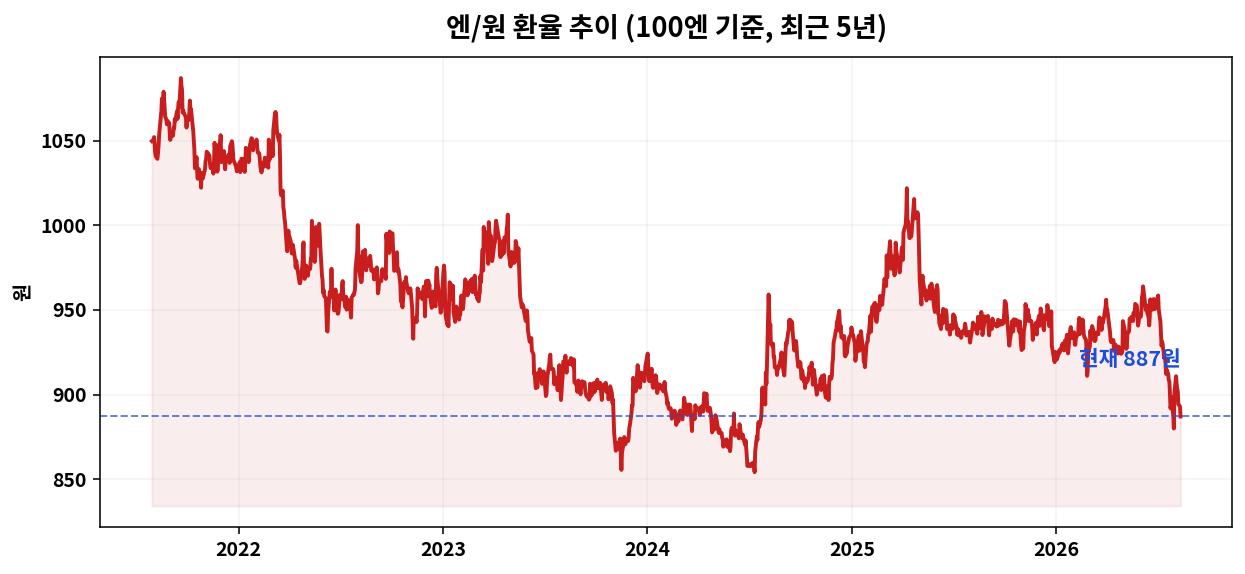
The chart above shows the yen-to-won (per 100 yen) over five years. It's dropped from around 1,050 won in 2021 to 887 won now—sitting at multiyear lows. Here's how different currencies stack up over one to five years:
| Currency | 1-year | 2-year | 3-year | 5-year |
|---|---|---|---|---|
| Yen (1 yen = 8.87 won) | -5.3% | -4.5% | -3.4% | -15.3% |
| Turkish lira | -13.3% | -27.6% | -39.7% | -77.9% |
| (Reference) Dollar | +1.6% | +3.0% | +6.5% | +21.9% |
This is where it gets interesting. A currency like the lira didn't get cheap—it's structurally melting away from chronic inflation. The lira's five-year drop of 78% proves it. That's a currency you shouldn't be buying. The yen is different—it's a developed-market currency with low inflation, yet it's fallen 15% over five years. By real effective exchange rate, it's at multidecade lows. So the yen is basically the only major currency where "cheap" actually makes sense. The dollar, by contrast, is up 22% over five years—it's expensive right now.
But here's the catch with the yen—zero interest
Looking at foreign deposit rates, the dollar earns 3.2% annually, the Australian dollar 4.16%—but the yen earns 0.00%.
| Currency | Foreign deposit rate (annual) |
|---|---|
| Yen (JPY) | 0.00% |
| Dollar (USD) | 3.23% |
| Australian dollar (AUD) | 4.16% |
| Pound (GBP) | 3.13% |
| Euro (EUR) | 1.82% |
So holding yen is purely about exchange-rate gains with no interest at all. The reason yen is cheap is Japan's ultra-low rates, and that's been stuck for years. Honestly, nobody can call when it'll rise. In a situation like this, it makes sense to dollar-cost average rather than dump it all in at once.
Not all foreign currency accounts are created equal
I once thought about doing some dollar investing and stuck some in Kakao Bank's Dollar Box. But when I actually tried to use it, it got pretty awkward. I couldn't transfer it to another bank's foreign account, couldn't send it overseas—basically all I could do was "park" the dollars there. That's when I learned that if you want to hold multiple currencies and actually convert and transfer between them, you need a multi-currency account. Here's how the banks stack up:
| Account | Supported currencies | Currency conversion | International transfer | Inter-bank transfer |
|---|---|---|---|---|
| Shinhan Foreign Exchange Plus | 21 currencies | Yes | Yes | Yes |
| Hana Million Dollar | 27 currencies | Yes | Yes (200 countries) | Yes (higher fees) |
| Woori Foreign Deposit | Major currencies | Limited | Yes | Yes |
| KB Foreign Savings | Major currencies | Limited | Yes | Yes |
| Kakao Bank Dollar Box | USD only | No | No | No |
If you want to hold multiple currencies like the yen and think about converting and transferring between them, you'll need an account that actually supports multi-currency and conversion between currencies. That said, exchange-rate premiums and fee structures vary by bank and change frequently, so it's best to check each bank's app directly for that day's rates before you actually sign up.
To sum it up
Right now: ① the won has surged in the short term, pushing foreign currencies down overall; ② among them, historically speaking, only the yen is really cheap; and ③ since yen earns zero interest, it only makes sense if you get the direction right. It started as a travel exchange story, but I wanted to point out that when looking at rates, the difference between being actually cheap and just looking cheap comes down to whether you're checking "six-month declines" or "multiyear levels". The actual call and timing? That's up to you.
Foreign currency and exchange rates carry the risk of principal loss. This piece is information gathering, not a recommendation to buy any particular currency or product. All investment decisions and results are your responsibility.
#exchangerate #yen #yenrate #wontoyen #japantrip #yeninvestment #foreigncurrencyaccount #currencyhacking #wontodollar #dollar #foreigndeposit #moneyhabits #exchange #shinhanforeignexchange #dollarbox #yenoutlook #exchangerateoutlook #investmentstudies
댓글
댓글 쓰기