[Featured Stock] Broadcom Stock Plummets -4.30%, Record Earnings But Credit Rating Becomes a Roadblock—Why?
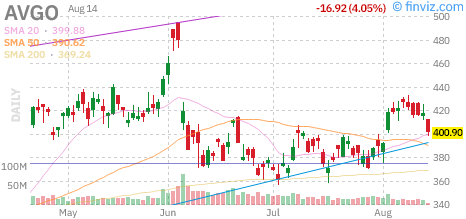
Broadcom (AVGO) took a nosedive today, dropping 4.30% and falling to around the $399 level. Here's the twist: the company's earnings are actually hitting record highs, but what really shook the stock wasn't the earnings report—it was a warning bell from the bond market.
Just days ago, Bank of America downgraded Broadcom's corporate bond rating from "overweight" to "neutral." Not because earnings are weak, but because of concerns about XPV, a $35 billion AI infrastructure finance platform Broadcom created with Apollo and Blackstone. That aftershock carried through to today, pulling the stock down again.
What's XPV, and why is it shaking credit ratings?
XPV is a joint financing structure Broadcom created to rent computing infrastructure to AI companies like Anthropic. Apollo Global Management and Blackstone are putting up the initial capital, while Broadcom supplies custom-designed AI chips (XPU) and networking gear. The plan is to build out 20 gigawatts of computing power by 2028.
BofA's beef is with the size of this structure's "residual value guarantee." By mid-2029, the guaranteed exposure could hit as much as $370 billion, and in a worst-case scenario, Broadcom could eat a loss of up to $42 billion. But here's the kicker—in the same report, BofA actually raised its 2026 revenue and EBITDA outlook for Broadcom by 10–13%. Pretty contradictory messaging: "The company's growing fine, but as this financial structure gets bigger, credit spreads will come under pressure."
Earnings Are Record-Breaking, So Why's the Market Nervous?
By the numbers, Broadcom's got nothing to apologize for. Recent quarter revenue keeps growing double-digits year-over-year, and AI chip revenue jumped 143%. The company's guiding for $56 billion in AI semiconductor revenue for fiscal 2026 (up about 180% year-over-year), and expects to cross $100 billion in 2027. Operating margins are holding at around 67%.
Yet the stock's still getting hammered because so much is already priced in. Broadcom's trading at a PER pushing 60x. At that valuation, even stellar results get hammered on a single signal of "slightly below expectations." Case in point: back in June, revenue was up 48% and AI revenue rocketed 143%, but when Q3 AI revenue guidance ($16 billion) fell short of the Street's expectations ($17.3 billion), the stock got crushed 15% in after-hours trading. The valuation itself isn't causing the drop directly, but it's like a megaphone that amplifies even tiny disappointments into massive selloffs.
And Memory Sector Noise Piled On

The timing didn't help. When word came out that SK Hynix was slowing its high-bandwidth memory (HBM4) expansion and shifting some production lines back to regular DRAM, it triggered questions about AI chip demand itself. Most analysts reckon it's actually a profitability call—DRAM margins are 15+ percentage points higher than HBM—but the market took it as "demand is cooling" and just started dumping semiconductor stocks across the board. Broadcom got caught in that selloff too.
Here's an interesting wrinkle: Broadcom recently teamed up with Samsung Electronics too. Last month at the San Francisco AI Summit, Samsung's foundry chief and Hock Tan, Broadcom's CEO, met to discuss custom chip design-manufacturing collaboration. Broadcom handles design, Samsung handles foundry and HBM packaging—a structure that fits the bigger tech-industry push to diversify away from Nvidia.
Analysts Still Say Buy

The proof that this crash isn't about damaged fundamentals? Look at price targets. Right now, roughly 30–50 brokerages are averaging targets around $500–520, which is 25–30% higher than where it's trading. Truist Securities even saw the June crash as a buying opportunity and raised its target to $510. When targets sit that far above the current price, it means the Street isn't saying "this is overvalued and I won't touch it"—it's saying "the fundamentals are fine, credit jitters just knocked the price down temporarily."
But the risks are real. A structure like XPV could flip from opportunity to debt burden if the AI investment cycle cracks. News of new customers—like the "Halapeno" AI chip Broadcom co-developed with OpenAI—is bullish, but we also need to keep one eye on just how much capital risk Broadcom is taking on from all these customers.

So, Where Does This Stock Stand?
Right now, Broadcom's sell-off is less about earnings and more about how a 'financial structure risk' rattled a highly-valued stock. The money the company's making is actually growing, and analysts haven't lowered their price targets.
There's one watchpoint going forward: whether credit spreads around the XPV platform keep widening or whether they settle after BofA's report. If spreads stabilize, this crash likely stays as "temporary correction unrelated to earnings." If they keep blowing out, that widening itself could signal the next leg down.
Right now the earnings sheet's smiling but the bond market's frowning. The next few weeks of spread movement will tell us which signal to trust.
US-listed stock; this is factual analysis, not a buy or sell recommendation. Any investment decision and results are on you.
#Broadcom #BroadcomStock #AVGO #USStocks #NASDAQ #SemiconductorStocks #AISemiconductors #XPV #BankofAmerica #CreditDowngrade #HockTan #SamsungElectronics #SKHynix #HBM #AIInfrastructure #SemiconductorSector #USStockMarket #PlungingStocks #PriceTarget #CustomSemiconductors #OpenAI
댓글
댓글 쓰기