You can work for over a year—fourteen months, say—and walk away with zero severance pay. The employer isn't withholding it. The law excludes you. If you believed one year of employment was the only requirement, there's a second condition that can disqualify you entirely. Based on Ministry of Employment and Labor and government legal resources as of October 1, 2026.
Here's who qualifies, who doesn't, the payment amount, and when it arrives.
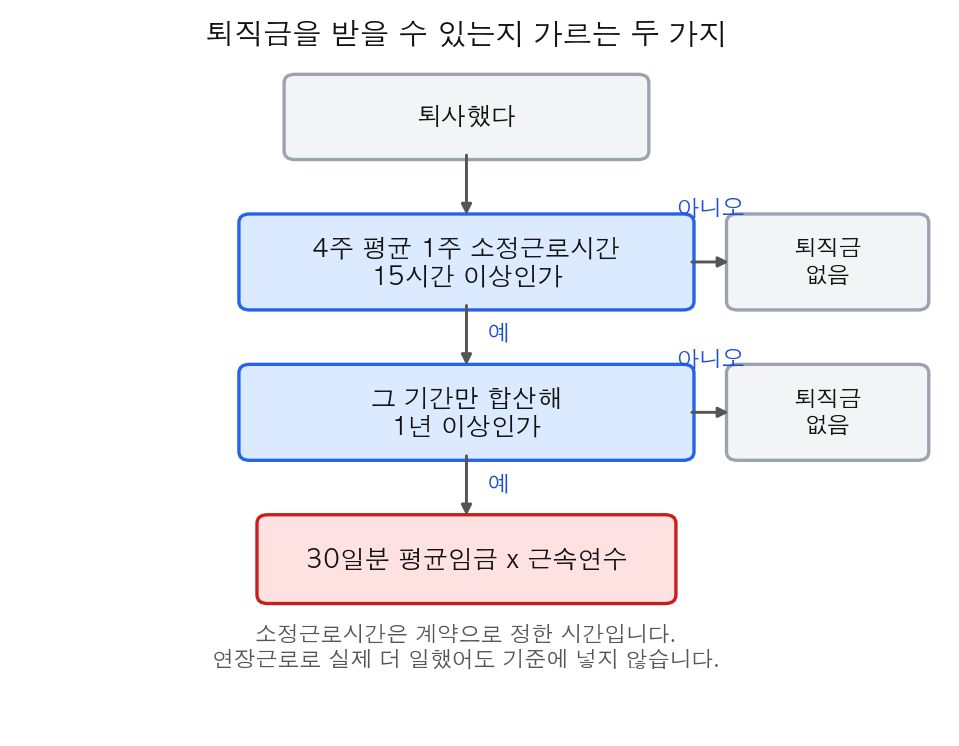
Compiled by author.
One year of work. Zero severance.
South Korea's Retirement Benefits Security Act sets a narrow eligibility gate: continuous employment of one year or longer, and a 4-week average of at least 15 hours per week of stipulated working hours. Miss either condition and you receive nothing.
The first condition is strict. "One year" means 365 calendar days. Work 364 days and you forfeit it entirely. A one-day difference. If your employer controls your departure date, this threshold is worth examining.
The second condition catches more people. Three shifts a week at four hours each equals twelve hours weekly. Three years at that level—no severance. This happens often in cafes and convenience stores, roles designed for short-hour labor. Many workers realize only after leaving that they were never eligible.
A frequent misunderstanding: the standard is not actual hours worked, but the contractual hours stated in the employment agreement. The Ministry's online advisory confirms: if the agreement specifies fewer than 15 hours weekly, you don't qualify. Even if overtime pushed your actual hours above 15, the severance obligation does not apply.
Your contract states twelve hours a week. You worked twenty because it was busy. Under the rules as written, you remain ineligible. It feels unfair, but that is the current standard.
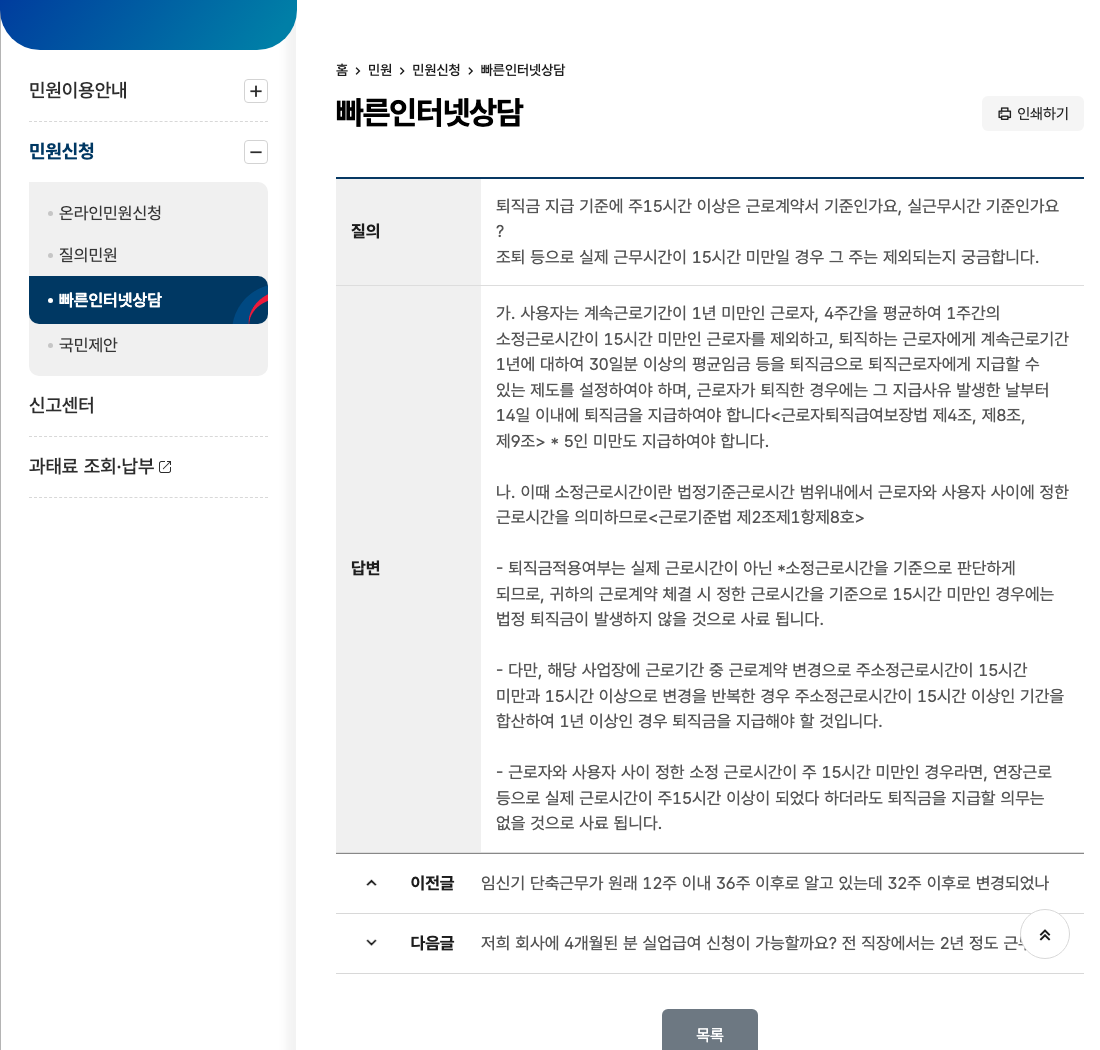
Ministry of Employment and Labor online advisory response, screenshot.
If your hours crossed the 15-hour line, only that period counts
This aspect is least widely known. Employment agreements sometimes change during tenure. Contractual hours may swing between below and above the 15-hour threshold. The Ministry's guidance is precise: only periods when stipulated hours met or exceeded 15 per week are counted toward the 1-year requirement.
Consider this scenario: you worked two years total. The first sixteen months were under a twelve-hour weekly contract. The final eight months jumped to twenty hours weekly. Only the eight months count. Your two-year employment certificate proves nothing. Severance: zero.
| Scenario | Severance |
|---|---|
| 40 hours per week, 11 months employment | None (below 1-year threshold) |
| 12 hours per week contract, 3 years employment | None (below 15-hour threshold) |
| 12 hours per week contract, actually worked 20 hours weekly for 3 years | None (contractual hours basis applies) |
| 20 hours per week, 1 year 2 months, 3-person workplace | Eligible |
Even a three-person shop must pay
The claim "we're under five employees, so no severance" circulates widely. The official guidance explicitly states: businesses with five or fewer employees must pay severance. Paid annual leave and supplementary allowances are exempted for small firms—this is where the confusion arises. Severance is different.
Probation and internship periods work the same way. If you remained in an employment relationship and performed work, that time counts toward continuous employment. Three months of probation plus ten additional months equals one year and three months. An employer cannot subtract probation days and claim you fell short of the one-year mark.

Government complex in Sejong. Houses the Ministry of Employment and Labor. (Source: Wikimedia Commons)
How much do you receive?
The formula is straightforward: 30 days' or more of average daily wage for each year of continuous employment. Expressed as: average daily wage × 30 × (days employed ÷ 365). It is not a full month's salary. One month of pay accumulates per year worked.
If your average daily wage is 100,000 won, one year yields 3 million won. Three years yields 9 million won. Ten years yields 30 million won.
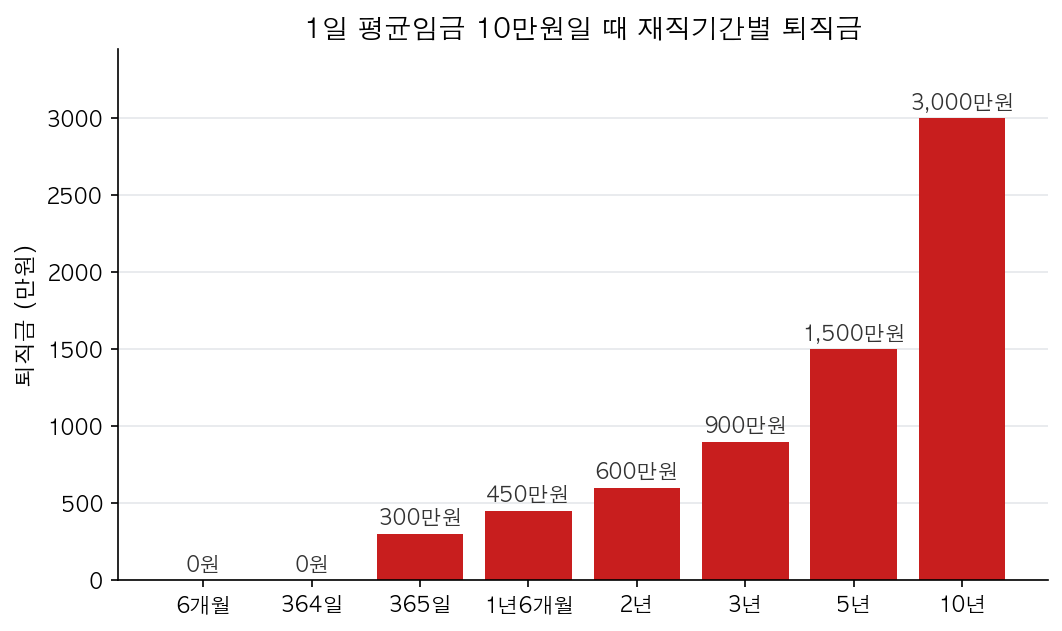
Compiled by author. Example assumes 100,000 won average daily wage.
Average daily wage is computed from the three months immediately before departure, divided by total days in that period. It includes more than base salary—regular allowances, bonuses, and accrued annual leave pay all factor in. This is why actual severance often exceeds a rough calculation based on monthly base pay alone. The Ministry's severance calculator on its website requires only your start date, end date, and three months of wage records. The result appears instantly. Maternity leave and parental leave periods are excluded.
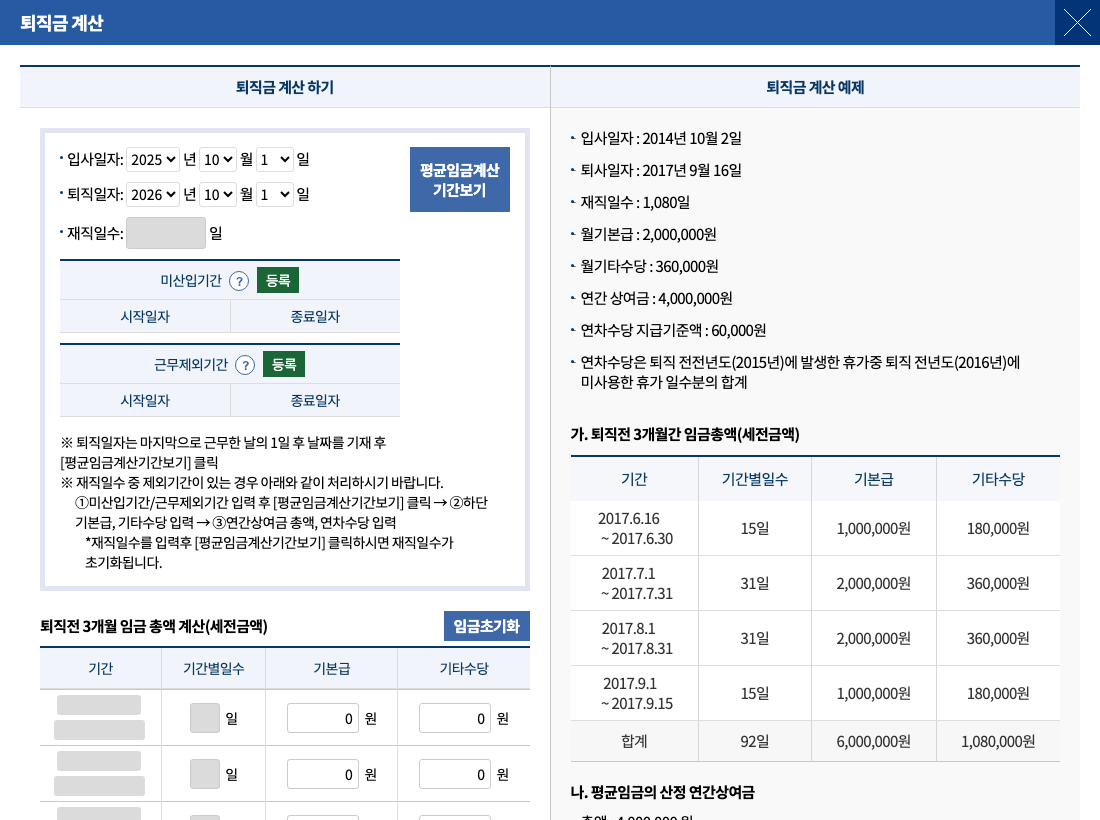
Ministry of Employment and Labor severance calculator, screenshot.
When does it arrive? After 14 days, interest accrues
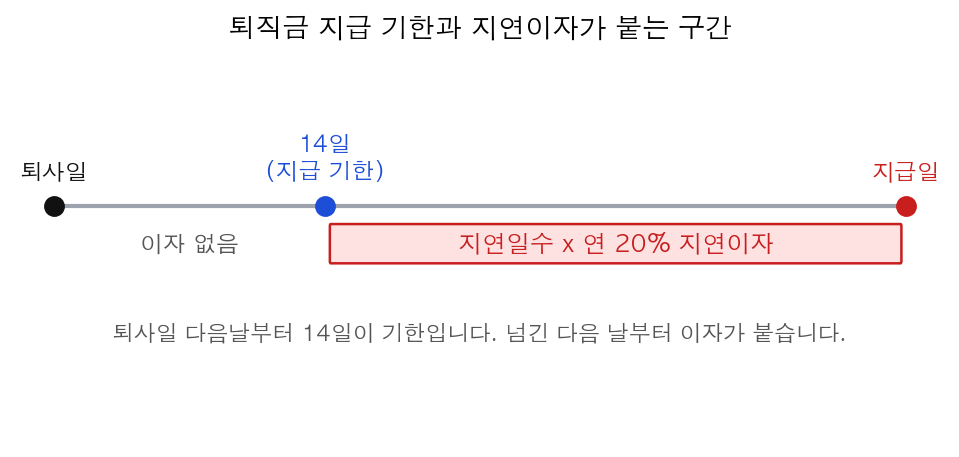
The deadline is within 14 days of your separation date. Not the next regular payday. It can be delayed only by mutual written agreement. Any delay beyond that is wage theft.
After the 14-day window closes, 20% annual interest accrues on the unpaid balance from the 15th day forward until payment. A 10 million won severance held for three months incurs roughly 500,000 won in interest alone. It is recoverable—yet many workers accept the principal and walk away unaware.
Compiled by author.
Interest is waived in specific cases: natural disaster, act of war, court-ordered receivership or bankruptcy, government-recognized insolvency, or conditions making fund recovery legally impossible. Interest also stops running if a court or labor tribunal deems the amount genuinely in dispute and appropriate for legal resolution. If the employer contests the calculation itself in court, the contested period may not accrue interest.
When employers refuse
Withholding severance carries criminal penalties: up to three years' imprisonment or a fine of up to 30 million won. Workers can file a petition with a local labor office requesting payment or file a criminal complaint. Both are available online through the Labor Portal or in person at your jurisdiction's labor office.
No written contract? Labor authorities will infer contractual hours from how work was actually performed—time records, shift schedules, pay stubs. Preserve these documents before leaving. Retrieving them later is far more difficult.
Civil litigation is an option. File suit in the district court with jurisdiction over the workplace or your residence, obtain a final judgment, and enforce collection. Which path to pursue—administrative or civil—depends on facts: whether the employer has assets to recover and whether the amount is genuinely disputed.
These standards apply across cases. Disputes typically hinge on facts: the contract's terms, work records, and whether an employment relationship actually existed. Your own situation may fall into gray area. Direct confirmation with your local labor office, a certified labor advisor, or an attorney is the only reliable method. The Ministry's customer service center (1350, no area code needed from within Korea) also provides telephone advisory.
Severance is subject to retirement income tax. The deductible amount varies by tenure and total payment. A tax office or tax professional can confirm your individual liability.
Two facts to retain: Did your employment contract specify 15 or more hours per week? Do your periods meeting that threshold sum to one year or longer? Contractual hours outweigh months of tenure. Before resignation, it's worth reviewing your employment agreement.
Sources: Ministry of Employment and Labor online advisory, Ministry severance calculator, and Government Legal Information System guidance on retirement benefits.
This article presents factual information about severance policy and does not constitute investment or legal advice. Judgment and consequences rest with the reader.
#SeverancePay #SeveragePayEligibility #SeveragePayRules #EmploymentLaw #ContractualHours #ContinuousEmployment #MinimumWage #RetirementBenefits #LaborLaw #KoreanLabor #EmploymentContract #WorkersRights #WageDispute #SmallBusiness #PartTimeWork #InternshipPay #ProbationPay #MinistryOfEmploymentAndLabor #EmploymentBenefit #LaborDipute #EmployeeProtection #SouthKoreaLabor #EveryDayFinance #WageTheft #EmploymentRights #LaborStandards #PaymentDeadline #LatePaymentInterest
댓글
댓글 쓰기