[New High] Josung Engineering Stock: How a Company With Operating Losses Reaches $8.8 Billion Market Cap
Josung Engineering closed at KRW 239,500 on October 1, up 3.01% from the previous day. It topped out at KRW 244,500 intraday and is within striking distance of its 52-week high of KRW 250,500. Market capitalization has crossed KRW 11 trillion.
The puzzle: the company posted an operating loss of KRW 5.6 billion in the first half of 2026. A company that isn't making money now carries a valuation of KRW 11 trillion. This article examines how that math works.
Two days. Two different catalysts.
September 29: up 6.22%. September 30: up 4.73%. October 1: up 3.01%. In four days, the stock moved from KRW 209,000 to KRW 239,500—a 14.6% gain.
What's instructive is that each day's rally rested on different news. On September 30, Elon Musk told a Washington conference that SpaceX aims to produce 200 gigawatts of solar capacity annually, in partnership with Tesla. Korean solar-related stocks moved together, and Josung rode that wave.
A day later, the catalyst shifted to semiconductors. South Korea's September semiconductor exports reached $63 billion—the first month any single product category exceeded $60 billion. That's a year-over-year jump of 262.8%. U.S. chipmaker Micron also topped earnings expectations. KOSDAQ surged 4.48% that day, led by semiconductor equipment makers.
The same company, two consecutive days, two entirely different stories. This works because Josung makes both semiconductor processing equipment and solar energy equipment. More on that later.
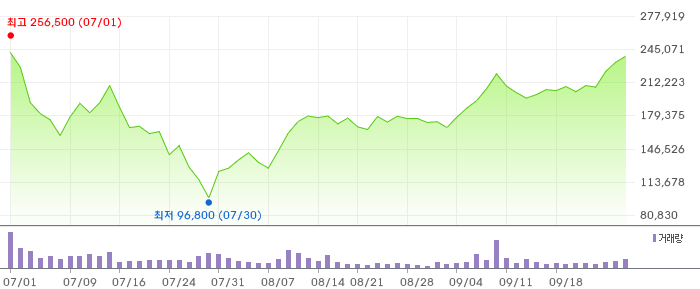
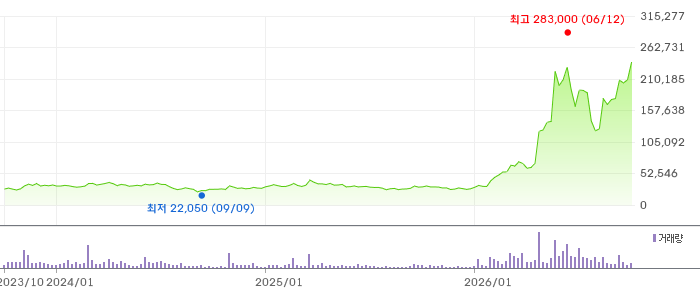
Stock price action: three-month and three-year views
Semiconductor equipment stocks all rallied. This one led the pack.
Josung wasn't the only winner. Comparing Korean semiconductor equipment makers over the same period:
· Three-month returns — Josung Engineering +24.4% / Hanmi Semiconductor +14.8% / Woonik IPS +6.8% / Eugene Tech +6.4% / TSS +1.9% / PSK −11.2%
· One-year returns — Josung Engineering +639.2% / PSK +420.6% / TSS +317.1% / Woonik IPS +211.6% / Hanmi Semiconductor +186.2% / Eugene Tech +182.1%
The median three-month return among six competitors was +6.4%. Josung's performance was roughly four times that. Stretched over a year, it leads the group by an even wider margin. The combination of tailwinds in the sector and company-specific strength shows clearly.
The problem: when you line up profitability metrics, the rankings invert.
· Operating margin — Hanmi Semiconductor 43.6% / PSK 19.4% / TSS 16.5% / Eugene Tech 14.8% / Josung Engineering 10.1% / Woonik IPS 0.0%
· Return on equity — Hanmi Semiconductor 31.0% / TSS 14.5% / Eugene Tech 9.1% / Woonik IPS 8.7% / Josung Engineering 6.0% / PSK 0.0%
· P/E ratio — Josung Engineering 317x / Hanmi Semiconductor 120x / Eugene Tech 99x / Woonik IPS 83x / TSS 63x / PSK 60x
Josung earns the least while trading at the highest multiple. Hanmi Semiconductor posts a 43.6% operating margin with a P/E of 120x. Josung posts 10.1% margins at a P/E of 317x. In plain terms: the market is not pricing this stock on current earnings.
The earnings trajectory is moving backward.
2024 was the high-water mark. The company booked KRW 409.4 billion in sales and KRW 97.2 billion in operating profit. That was a solid year—an operating margin of 23.7% and a return on equity of 18.9%.
Then the decline. 2025 sales fell 24.1% to KRW 310.7 billion, while operating profit collapsed 67.8% to KRW 31.3 billion. Earnings were cut to one-third in a single year. In the first half of 2026, the company swung to an operating loss of KRW 5.6 billion.
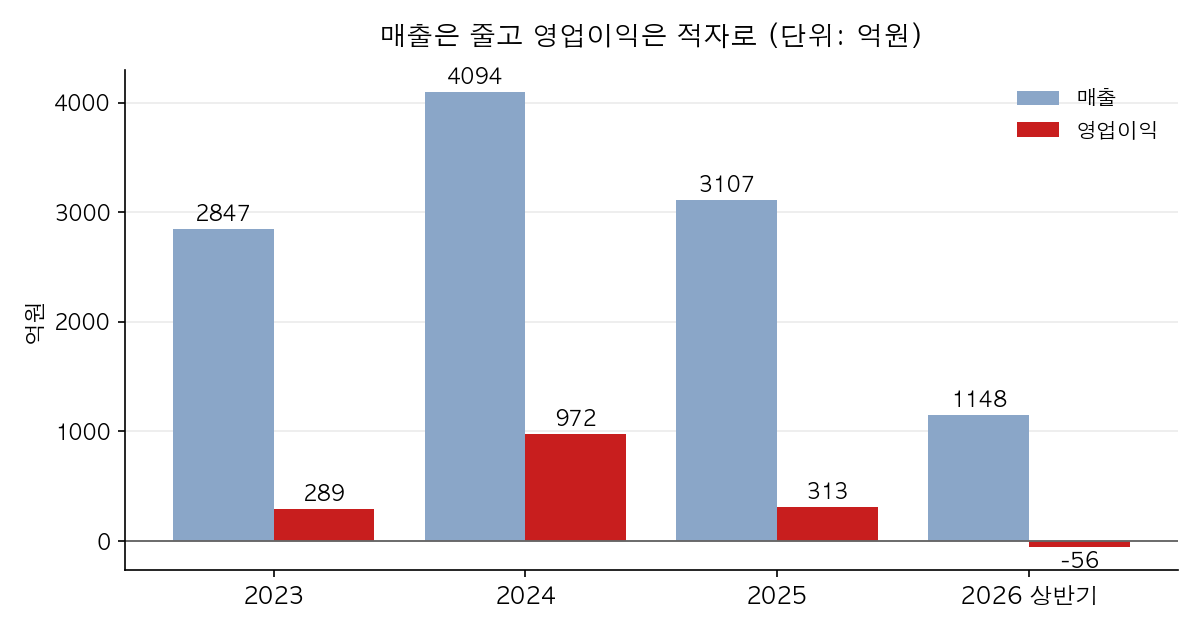
Looking at quarters: Q2 posted KRW 59.88 billion in sales and KRW 1.423 billion in operating profit. Sales were down 24.0% year-over-year, and operating profit fell 78.4%. Net income came to KRW 5.501 billion, up 9.1% YoY—which means net earnings exceeded operating earnings. Something outside operations generated income; the specific details remain unclear.
Q1's operating loss gave way to Q2's modest profit, suggesting the bottom may have been reached. The gap between falling losses and recovering earnings is not trivial. H1 as a whole remains negative.
Where did the earnings go
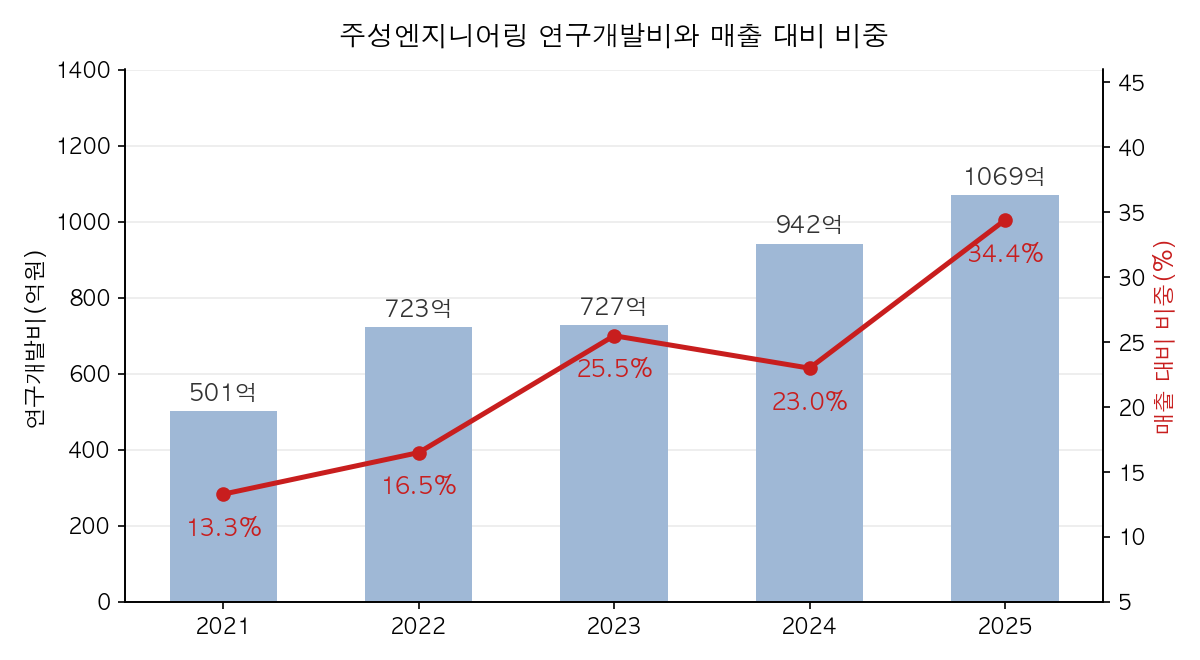
Declining sales aren't the whole story. The company is channeling profits into research and development.
R&D spending jumped from KRW 50.1 billion in 2021 to KRW 106.9 billion in 2025. As a percentage of sales, it rose from 13.3% to 34.4%. Out of KRW 310.7 billion in revenue, KRW 106.9 billion goes to the research wing. For every KRW 100 in sales, KRW 34 flows to R&D. Operating profit was KRW 31.3 billion—less than one-third of R&D spending.
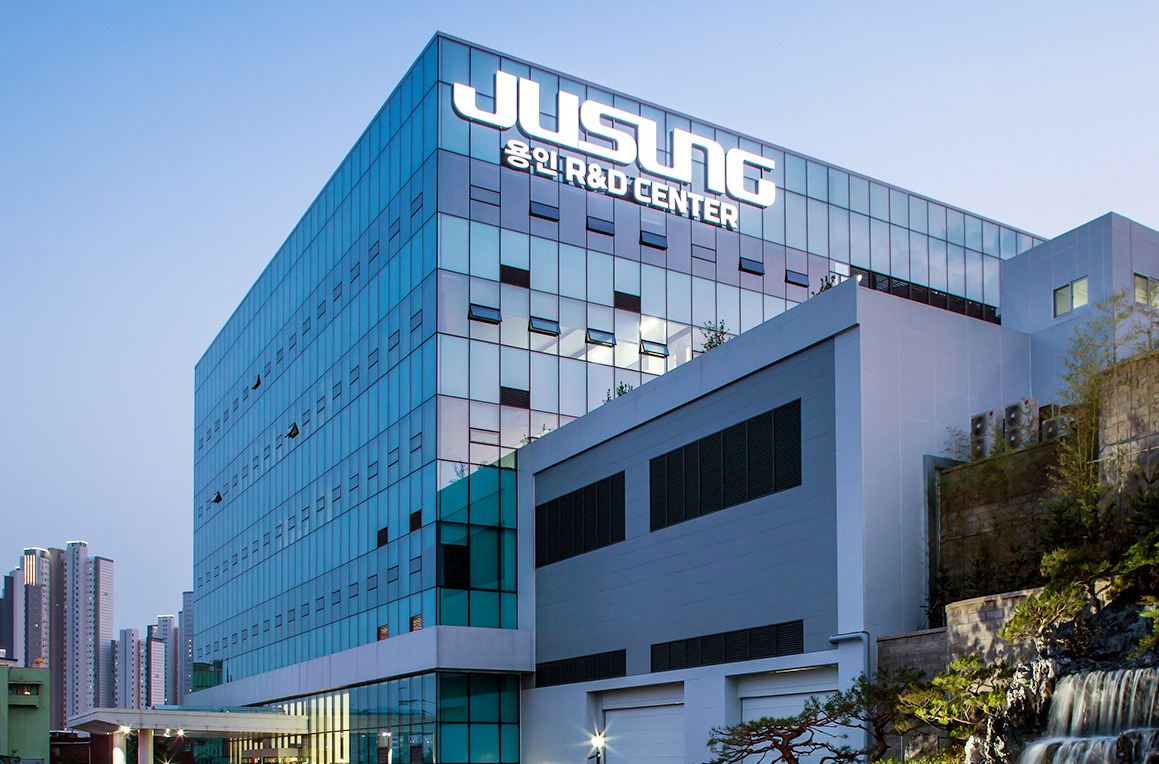
R&D Center in Yongin, Gyeonggi Province (Herald Economics)
Headcount follows the same pattern. As of 2024, roughly 63% of the company's workforce is in research and development roles. Chairman Hwang Chul-ju has explained that the company consistently invests 20-30% of revenue in R&D. The company has also announced plans to invest an additional KRW 104.8 billion in a second research facility in Yongin through 2028.
What is it building? The company's flagship technology is atomic layer deposition (ALD) equipment, which it first commercialized worldwide in 1997. This tool deposits nanometer-scale films onto semiconductor wafers—essential as circuits shrink. The company is developing additional capabilities in atomic layer thin-film growth. Chairman Hwang has stated that Josung is the only firm to possess all three core processes: chemical vapor deposition (CVD), atomic layer deposition, and atomic layer thin-film growth.
Solar energy is a second pillar. More than 70% of current revenue comes from semiconductors. The company is leveraging its thin-film technology to develop tandem solar cells. That is why Musk's September 30 comments moved this stock. But how much of actual revenue tandem solar currently contributes remains unconfirmed.
At least it didn't come from shareholder dilution.
When an unprofitable company ramps R&D, a natural question arises: where does the money come from? A review of public filings shows:
· Convertible bonds and warrants issued — 0
· Share issuances — 0
· Stock splits — 0
· Share buyback authorizations — 2 (July 2024 and February 2026)
· Cash dividends declared — 5
There is no record of equity raises. Instead, the company has repurchased shares and paid dividends. The debt-to-equity ratio at the end of 2025 stood at 50.4%, down from 74.2% at the end of 2024. The company appears to be funding its R&D expansion from accumulated cash and operating cash flow rather than by diluting shareholders.
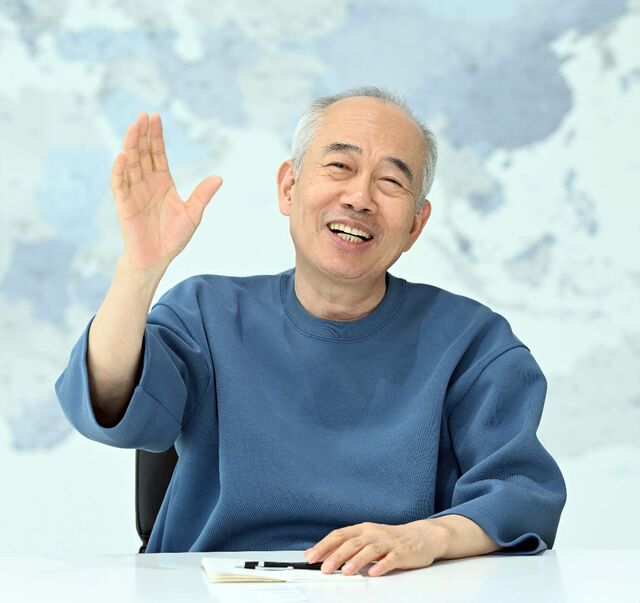
Founder and Chairman Hwang Chul-ju, who established the company in 1993 (Kookmin Ilbo)
Foreign investor ownership has ticked upward. From 8.00% on August 26 to 9.71% on October 1—a 1.71 percentage-point increase in just over a month.
One more note: the most recent analyst targets I found were from spring. Korea Investment & Securities issued a Buy rating on April 29 with a KRW 189,000 target. BNK Investment had a Hold on April 27 with a KRW 120,000 target. Both are well below the current price of KRW 239,500. No updated targets have been published since. Analyst estimates are trailing the stock price.
So where does this stock stand now
The valuation is disconnected from current earnings. This is unmistakable. A company with a 10.1% operating margin carries a P/E of 317x, and its most recent half-year was unprofitable. The current price is not supported by the 2025 income statement. It rests instead on Chairman Hwang's bet that the KRW 106.9 billion he has poured into the research lab will generate returns in years ahead. This is an article of faith.
Whether that faith holds or fractures hinges on one number: Q3 sales. Q2 revenue of KRW 59.88 billion was down 24.0% from a year earlier. If September semiconductor exports truly topped $60 billion for the first time, the equipment maker's sales should show that tailwind. The next inflection point is the Q3 earnings release.
If sales grow again, the P/E of 317x will begin to compress. If not, this valuation rests on narrative alone.
This article is an informational summary of publicly available quotes, corporate disclosures, and news reports and does not constitute investment advice or a recommendation to buy or sell.
#JosungEngineering #036930 #SemiconductorEquipment #ALD #AtomicLayerDeposition #HwangChulJu #KOSDAQ #SouthKoreaExports #SolarEnergy #TandemSolarCells #HanmiSemiconductor #MicronTechnology #EquipmentMaker #MarketAnalysis #EarningsRecession
댓글
댓글 쓰기