Wednesday brought divergent signals from Wall Street. Headline indices appeared muted—except the Dow, which fell 443.87 points, or -0.86%, closing at 50,906.05. The Nasdaq, by contrast, rose 0.24%, creating a split within the same session.
Two forces drove the rift. First, inflation. August core PCE came in at 3.0%, below the expected 3.3%, pushing October rate-hike odds to 37% from above 70% just a week prior. But long-dated Treasuries moved the opposite direction: the 30-year yield climbed to 5.64% and the 10-year to 5.29%. While near-term rate-hike fears eased, longer-term borrowing costs climbed.
After the close, Micron delivered the session's headline: quarterly revenue of $54.23 billion, up from $11.32 billion a year ago. That move will likely set the tone for Korean semiconductor stocks today.
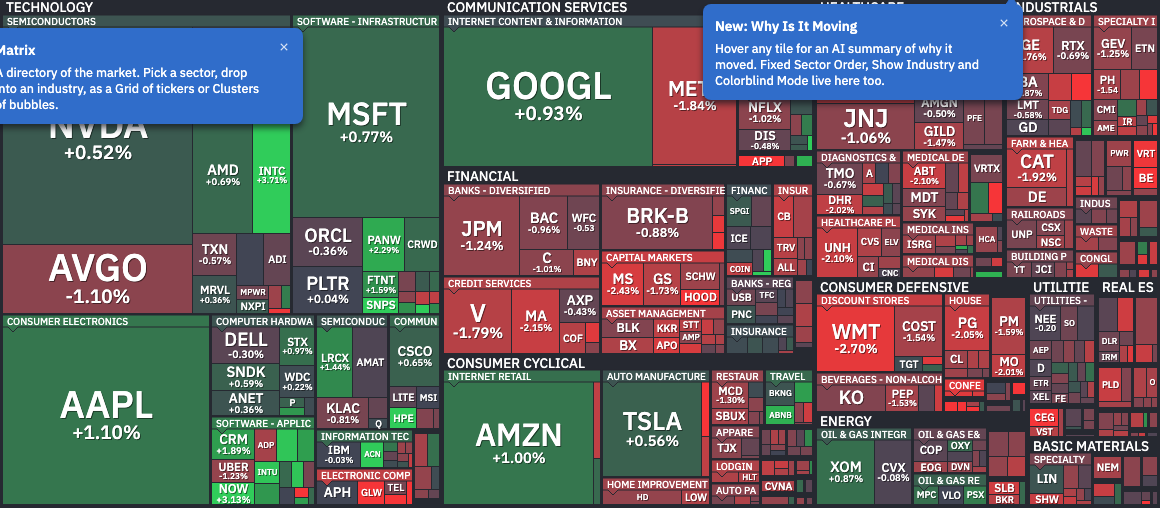
S&P 500 sector heat map, September 30 close. Green indicates gains; red, declines. (finviz)
U.S. Markets: Dow Trails as Tech Holds
Wednesday's close:
| Index | Close | Change |
|---|---|---|
| Dow | 50,906.05 | -0.86% |
| S&P 500 | 7,651.54 | -0.25% |
| Nasdaq | 26,861.06 | +0.24% |
| Philadelphia Semiconductor Index | 12,628.62 | -0.00% |
The Dow's 443-point drop extended September weakness; the index fell 4.9% for the month while the Nasdaq gained 1.7%. Large-cap tech held ground while traditional blue chips fell away—a pattern that persisted throughout September. Alphabet, Apple, and Microsoft each rose between 0.77% and 1.10%. Meta declined 1.84%. Toy maker Mattel dropped 3% after announcing a CEO change.
The divergence reflected sector rotation rather than panic. Tech resilience came as inflation data turned softer than feared.
Inflation Eases, but Long-Term Yields Rise
August PCE, the Federal Reserve's preferred inflation gauge, rose 3.4% year-over-year, below the 3.7% consensus. Excluding volatile food and energy, core PCE stood at 3.0%, well below the expected 3.3%. Both misses triggered an immediate market repricing.
CME FedWatch data showed October rate-hike odds collapsing to 37% from 70% the prior week. Suddenly, a November or later pause looked more plausible. Yet market relief stopped at the short end. The 10-year Treasury yield held at 5.29%, and the 30-year moved up to 5.64%—marking fresh 24-year highs.
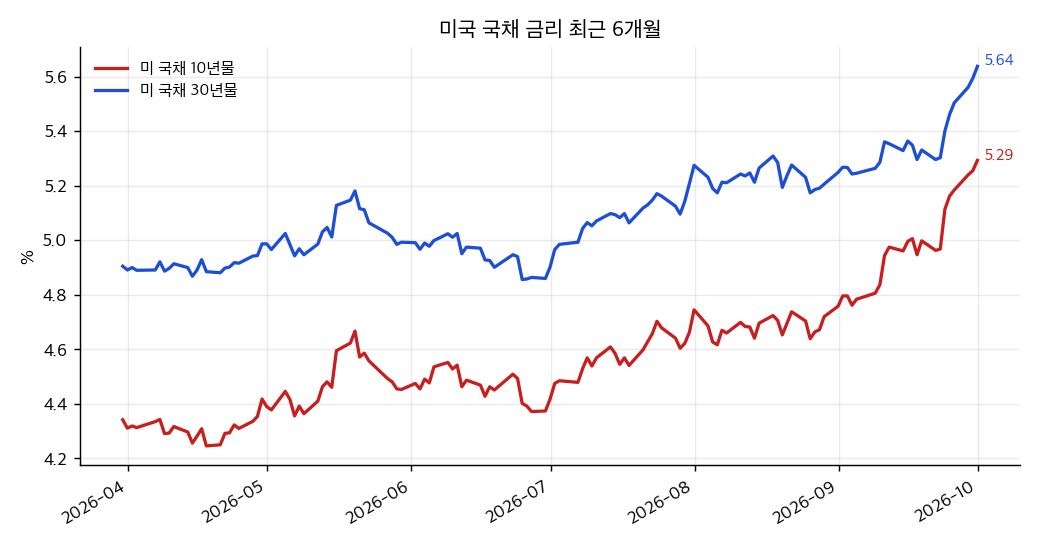
U.S. Treasury yields, 10-year and 30-year, 6-month span (author-compiled)
The separation is instructive. The Federal Reserve controls short-term rates. Markets price long-term rates. Right now, the market is pricing not relief from near-term rate risk, but rather the volume of future borrowing the U.S. government and corporations will need. Longer yields rising even as rate-hike odds fall suggests bond traders see sustained fiscal demand ahead.
For Korean markets, the implication is straightforward: when long-dated U.S. yields climb, dollar assets become more attractive. Foreign investors have less reason to hold Korean equities. That headwind has persisted for four straight sessions on the KOSPI.
Micron's After-Hours Results
The real event came after the closing bell. Micron reported fiscal Q4 results: quarterly revenue of $54.23 billion, compared with $11.32 billion a year ago. That's a 4.8-fold increase. Adjusted earnings per share came to $33.42, topping the $31.61 consensus. Management guided next quarter at roughly $61.5 billion—suggesting further growth ahead.
Micron closed Wednesday at $1,065.11, essentially flat in the regular session before the results landed. The market's answer begins today.
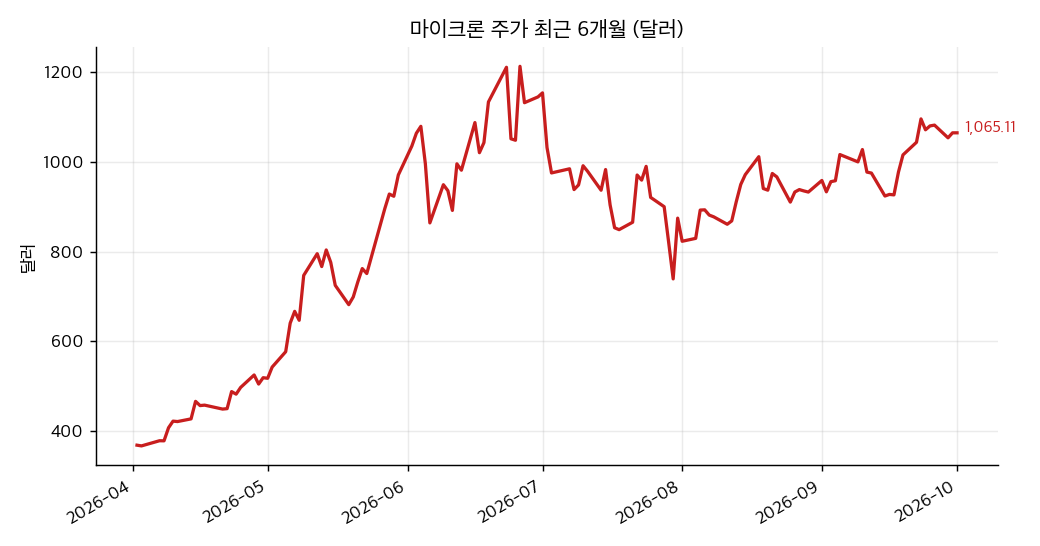
Micron Technology, 6-month price action. Close: $1,065.11. (author-compiled)
A memory-chip manufacturer posting four-fold revenue growth in a single year is not routine. The surge reflects extraordinary demand for high-bandwidth memory (HBM) used in AI servers. But the results came with caveats. Micron flagged substantial capital investment plans, which some observers view as a headwind. Whether growth or capex concerns dominate the stock's reaction remains to be seen—the market will decide today.
Semiconductor Index: No Movement, Mixed Internals
The Philadelphia Semiconductor Index closed at 12,628.62—essentially unchanged from 12,629.16 the prior day. A swing of 0.54 points conceals meaningful intraday action that ultimately led nowhere.
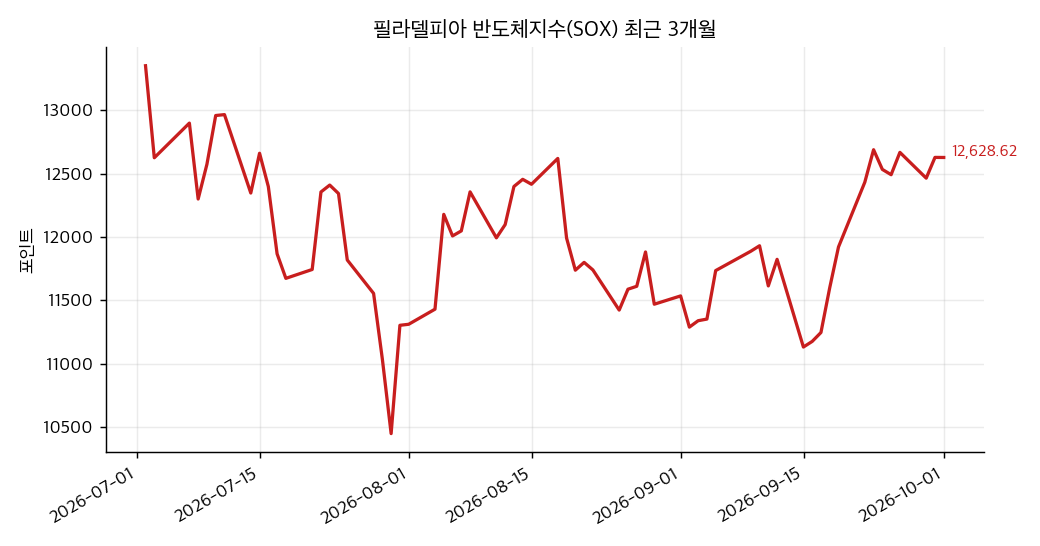
Philadelphia Semiconductor Index, 3-month chart (author-compiled)
Beneath the surface, stocks diverged sharply. Nvidia, AMD, and Lam Research rose between 0.51% and 1.44%. Intel jumped 3.71%. But Broadcom fell 1.10%, and ASML slid 1.24%, with TSMC down 0.16%. Equipment makers and fabless designers moved in opposite directions, leaving the index adrift.
Within Korea, this index is often watched as a leading indicator for Samsung Electronics and SK Hynix. Wednesday offered no clear direction. Instead, Micron's results step into that forecasting role.
Dollar and Oil Find Their Direction
The dollar index rose to 101.46—a classic response to higher long-term yields. The USD/KRW rate stood at 1,352.8 won per dollar as of 3:30 p.m. Seoul time on September 30, down 1.2 won from the prior close. Offshore trading pushed the pair back toward 1,356 overnight.
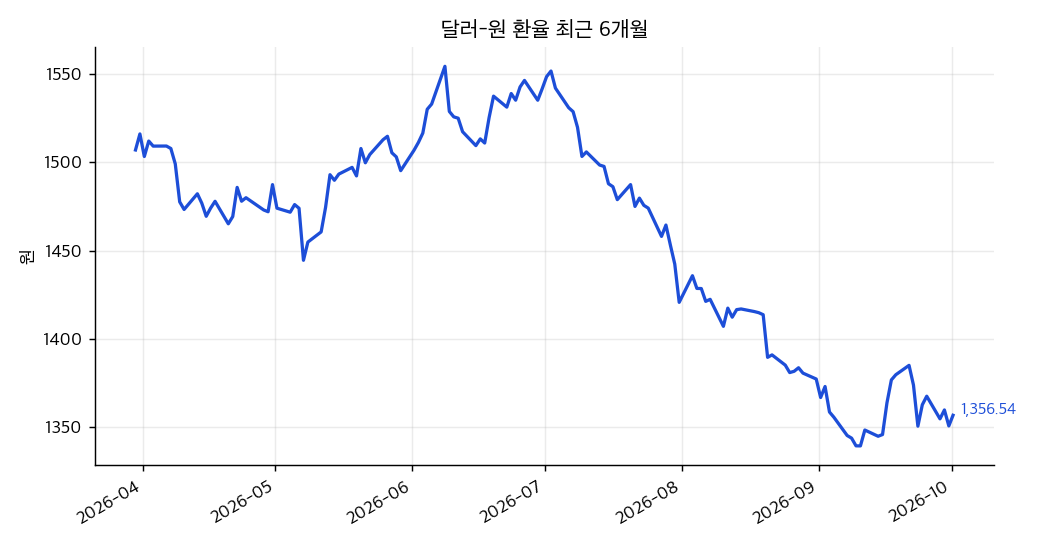
USD/KRW exchange rate, 6-month trend (author-compiled)
For foreign investors holding Korean equities at 1,350 won, currency risk looms large. If the won weakens faster than Korean stocks appreciate, there is no net gain. That exchange-rate overhang has compounded the equity headwind.
West Texas Intermediate crude reversed course, rising to $90.34 per barrel after a 3.48% plunge to $89.38 following news of Saudi Arabia's Red Sea oil-export resumption. Gold climbed to $4,189 per troy ounce.
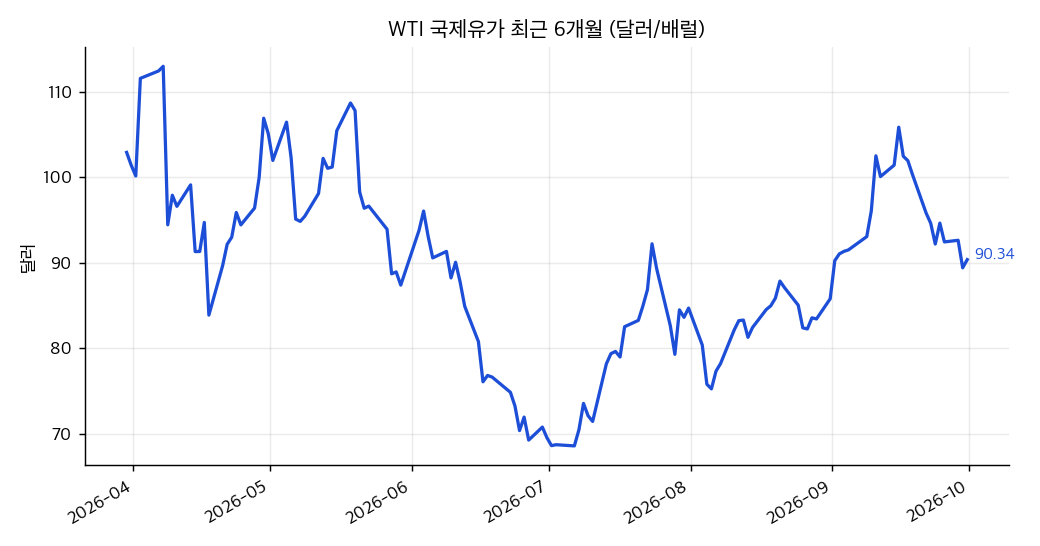
WTI crude oil, 6-month chart (author-compiled)
Asian Markets Led by Japan Strength
Asian bourses mostly advanced on September 30. Japan's Nikkei surged 1.94%, leading the region. Taiwan's weighted index rose 0.65%, Hong Kong's Hang Seng gained 0.37%, and China's Shanghai Composite climbed 0.31%.
China's September manufacturing PMI came in at 50.1, crossing the 50-point expansion threshold for the first time in two months. Japan, however, showed weakness: August industrial production fell 1.7% month-over-month, the opposite of the expected 1.7% gain. Yet Japanese equities rose anyway—a sign that investors looked past the data or found hope in other signals.
Korea stood apart. The KOSPI fell 32.77 points, or -0.48%, closing at 6,838.04—marking four consecutive declines. The KOSDAQ, by contrast, rose 6.11 points to 855.91, extending a four-day winning streak. Buying in semiconductor and battery names, attributed to both retail and institutional investor interest, lifted the KOSDAQ while the broader KOSPI struggled.
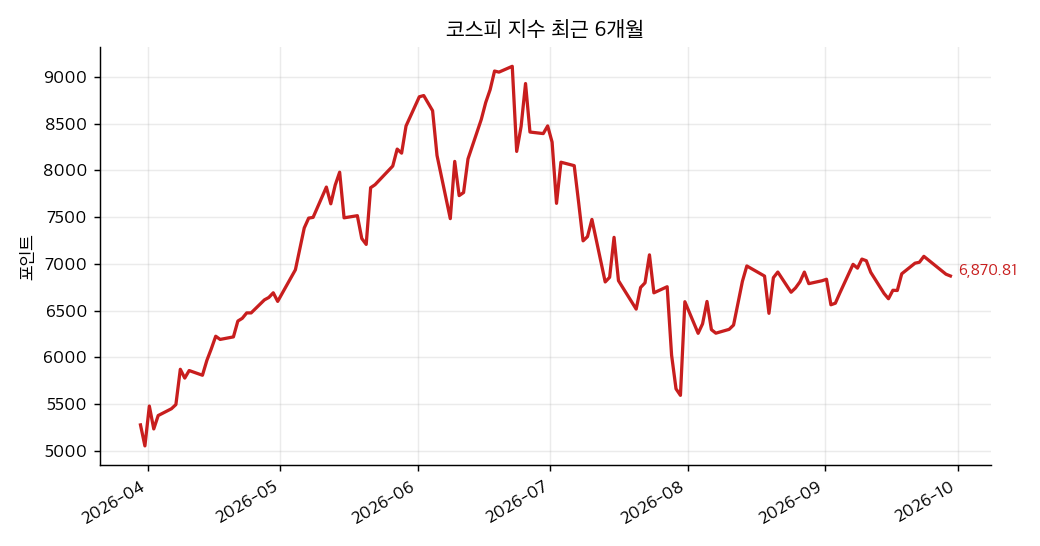
KOSPI index, 6-month price action (author-compiled)
What to Watch in Today's Korean Market
First: How Samsung Electronics and SK Hynix react to Micron's results. Micron competes in the same memory-chip market. Its quarterly revenue and forward guidance serve as an industry barometer. The key numbers to track: $54.23 billion in quarterly revenue and a next-quarter outlook near $61.5 billion.
Second: Foreign investor flows. The KOSPI has declined for three consecutive trading sessions amid steady foreign selling. With the 30-year U.S. yield holding above 5.6%, that headwind persists. The outcome today will hinge on whether earnings momentum or yield pressure dominates.
Third: Currency levels. Holding the 1,350 won line is a critical inflection. A move above 1,360 won during the session could trigger additional selling, independent of index movement.
Several scheduled events loom. AMD CEO Lisa Su is expected in Korea next month. Nvidia has scheduled its "AI Day Seoul" conference at COEX in November. Semiconductor and AI sector headlines will likely intensify over the coming weeks.
A cautionary note: The Philadelphia Semiconductor Index itself did not budge Wednesday. One company's blockbuster results carry no guarantee of sector-wide gains. History shows instances of strong earnings followed by profit-taking.
Bottom Line
Wall Street absorbed two conflicting signals overnight: inflation relief on the near term, but rising long-term borrowing costs. The Dow fell while the Nasdaq held. After the close, Micron posted a quarterly revenue surge to $54.23 billion from $11.32 billion a year ago—a potent signal for Korea's chip sector. Today's Korean market will reveal which factor carries more weight: earnings acceleration or the drag from higher U.S. long-term yields and a rising dollar. Watch foreign investor flows from the open.
This article presents publicly disclosed market data and corporate guidance. It does not constitute investment advice or a recommendation to buy or sell any security.
#KOSPI #USMarkets #Micron #MicronEarnings #Nasdaq #SemiconductorIndex #TreasuryYields #PCEInflation #FederalReserve #SamsungElectronics #SKHynix #HBM #ExchangeRate #CrudeOil #SemiconductorOutlook #KOSDAQ #AsiaMarkets #USEquities #MarketOutlook #MarketOpen
댓글
댓글 쓰기