[Korea Market Close] KOSPI Closes at 6,971—How the Index Surged 2% When Retail Investors Dumped Over KRW 1 Trillion
The KOSPI index closed Wednesday at 6,971.35, up 133.31 points, or 1.95%. Yet retail investors were net sellers of KRW 1.43 trillion. How did the benchmark climb when the largest domestic player was heading for the exits?
The answer lies in who had bigger orders. Institutional investors reversed course to net buy KRW 334.8 billion, while other corporations swept up KRW 1.65 trillion. Foreign investors sold for the fifth consecutive session but at a declining pace—KRW 548.1 billion, less than half the recent daily average.
The index fell 1.07% midday. What turned it around?
KOSPI opened 0.34% lower and weakened further. By late morning it had tumbled to 6,765.06, marking an intraday trough of -1.07%.
Sentiment shifted during late morning. The index climbed back through 6,900 in the afternoon, pared losses, and closed near the day's high. The swing from trough to close exceeded 3%.
The catalyst arrived from the U.S. Micron Technology reported fiscal 2026 Q4 results: revenue of $54.23 billion, a substantial sequential jump. Adjusted earnings per share came in at $33.42, topping Wall Street's consensus of $31.72. Adjusted gross margin of 87% exceeded expectations at 86.2%—a sign that demand for AI data-center memory remains robust.
The same day, South Korea's Ministry of Trade, Industry and Energy released September export data: $120.94 billion, up 83.5% year-over-year. It was the first month ever that total exports surpassed $120 billion. Semiconductor exports alone reached $60.3 billion—a 262.8% year-over-year surge and the first time that category exceeded $60 billion monthly. The dual data points drove Samsung Electronics and SK Hynix higher: +2.79% and +3.21%, respectively. That became the session's dominant theme.
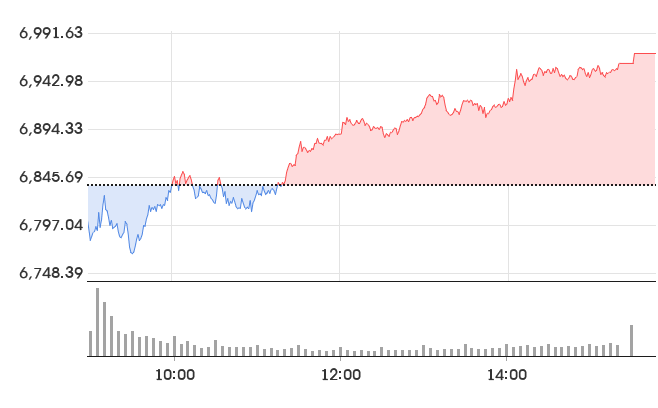
KOSPI daily chart (NaverFinance; red = up / blue = down)
Semiconductors and biotech gained; banks fell
By sector, medical devices/precision equipment, pharmaceuticals, electrical/electronics, and securities led the advance, up 5.65%, 2.89%, 2.84%, and 2.70% respectively. Chemicals and construction lagged slightly. Financials stood apart: Shinhan Financial Group (-2.17%), KB Financial (-1.66%), Hana Financial Group (-1.31%), and Woori Financial Group (-4.73%) all moved counter to the broader index.
Semiconductors and biotech had another tailwind. October hosts a cluster of pharma and biotech conferences, sparking anticipation. That single catalyst moved Samjin Pharm (+15.39%), Samsung Biologics (+2.73%), and Celltrion (+3.32%) in tandem. Bank stocks diverged without an obvious Korean catalyst; the apparent spillover came from U.S. financial and insurance shares struggling overnight under higher-rate pressure.
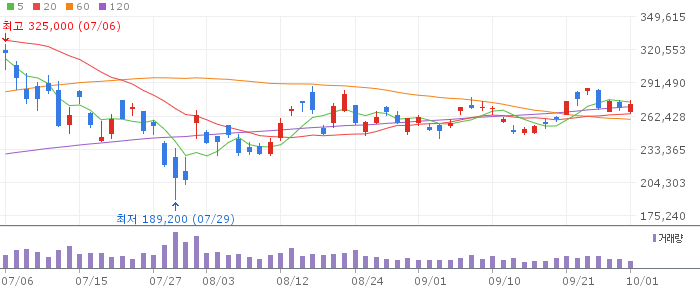
Samsung Electronics daily chart (NaverFinance; red = up / blue = down)
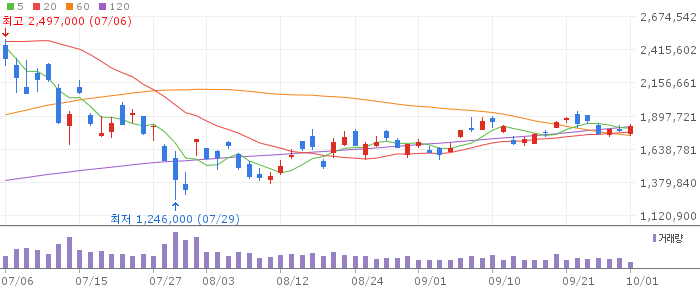
SK Hynix daily chart (NaverFinance; red = up / blue = down)
KOSDAQ ran twice as hard—up 4.48% to 894.29
The KOSDAQ index finished at 894.29, up 4.48%, marking five consecutive days of gains. Unlike the KOSPI, foreign investors and institutions both bought: KRW 233.0 billion and KRW 567.8 billion respectively. Retail investors were net sellers of KRW 777.7 billion.
Semiconductor equipment and materials names powered the rally. Rino Industrial (+10.90%), Wonik IPS (+9.13%), Iotech (+8.46%), HPSP (+8.32%), and Simtec (+6.25%) posted double-digit gains. Brils, a new listing, priced at KRW 19,500 and soared 56.15% on its debut day.
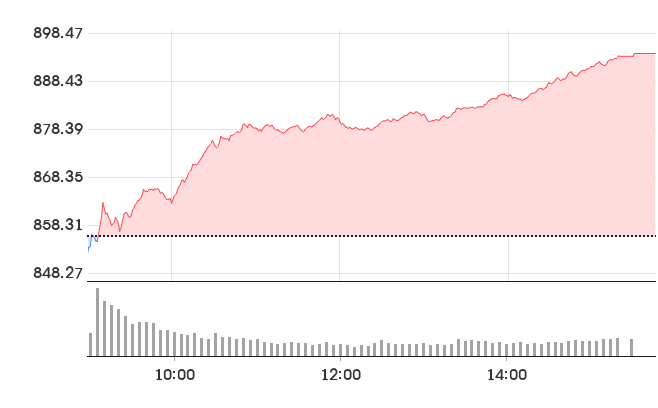
KOSDAQ daily chart (NaverFinance; red = up / blue = down)
Daily movers: one story of contracts, another of sector sentiment
Two stocks hit the daily limit. Wonil TNI (+29.94%) rose after the U.S. government announced investment plans in Korean energy, bundling LNG and nuclear themes. Daekhwee Electronics (+29.90%) had a direct trigger: it secured roughly KRW 400 billion in backlog orders over five years for cylindrical battery components.
Gainers elsewhere reflected individual announcements. DIA (+13.08%) won a KRW 15.3 billion semiconductor inspection-equipment contract from Samsung Electronics. CK Solutions (+7.95%) booked a KRW 22.9 billion LG U+ construction project. One notable outlier: Cosmo Robotics (+15.03%) jumped even as it disclosed that police had conducted a search on suspicion of revenue manipulation—a development that typically would weigh on a stock. The market's reasoning remains unclear at press time.
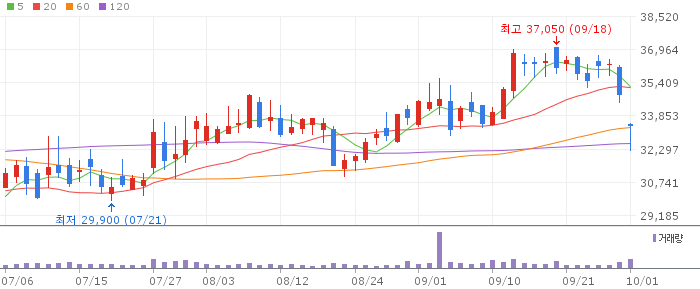
Woori Financial Group daily chart—the worst performer among banks today (NaverFinance; red = up / blue = down)
A thirty-year look at days like this
How often does the KOSPI fall 1% intraday but finish up 1.5 percentage points or more from its trough? We examined 7,284 trading days of KOSPI data from 1996 to today. The count: 78 occurrences, or roughly 1.1% of all sessions. In other words, once every four months on average. Not frequent, but not rare.
The most recent comparable session was July 3, when the index fell to -4.67% intraday before closing at +4.50%—a far more extreme reversal. Today's swing was gentler but directionally similar. The lesson: an opening tumble does not tell you how the day will end. Today proved it once more.
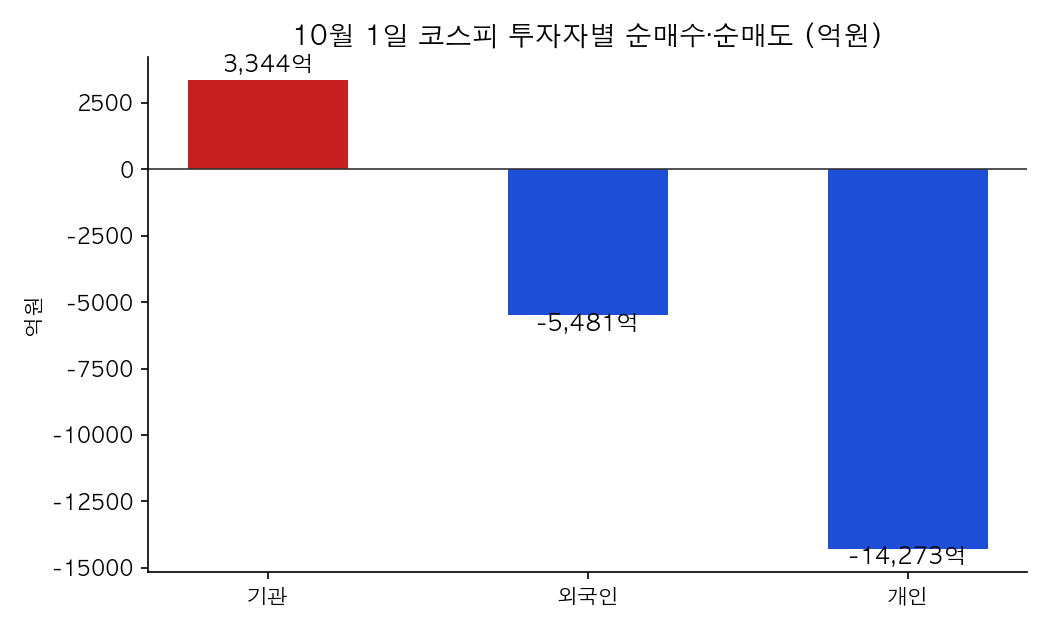
Compiled by author
Summary
Today's rally was not retail-led; it was institutional and corporate bid underneath. The next pivot point is when foreign selling dries up. They have sold for five consecutive days, but volume has been declining each session.
For related context, see the prior session recap on why the KOSPI gained 94 points intraday before retreating, amid 30-year Treasury moves, and the companion U.S. market brief on the Micron earnings surge and 30-year yields at 5.64% colliding on the same day. Reading both pieces back-to-back clarifies the flow.
Investment decisions and their outcomes rest with you. This article is for informational purposes only and does not constitute a recommendation to buy or sell any security.
댓글
댓글 쓰기